Salesforce
Artificial Intelligence
The Customer Zero Playbook for Agentic Enterprise
Article

Arnab Mukherjee
6
min read

AI agents represent a shift in how software contributes to enterprise outcomes. They are not just another interface layer or incremental improvement in automation. They introduce the ability for systems to interpret context, make decisions within defined boundaries, and execute tasks across workflows. This changes the role of software from supporting work to actively completing it.
Most enterprise systems today are designed to manage interactions. They classify requests, retrieve information, and route tasks across predefined processes. While effective at organizing demand, they rarely resolve it end-to-end. As workflows become more complex and interconnected, this gap between response and execution becomes more visible.
This shift is not just conceptual. It becomes visible in real enterprise environments, where systems designed to manage interactions begin to show limits under operational complexity.
When Enterprise Support Stops Scaling
This structural limitation becomes more visible at enterprise scale. Salesforce’s internal IT function, responsible for supporting a global workforce of over 76,000 employees, was managing approximately 25,000 support tickets each month. At this level of demand, support is no longer a contained operational function. It becomes a critical dependency for execution. Many of these requests are not peripheral; they directly affect an employee’s ability to access systems, complete tasks, or move work forward.
As volumes increase, delays compound. What begins as isolated inefficiencies gradually translates into stalled workflows, slower development cycles, and reduced organizational throughput. The system continues to operate, but its effectiveness diminishes under sustained load.
The Customer Zero Model
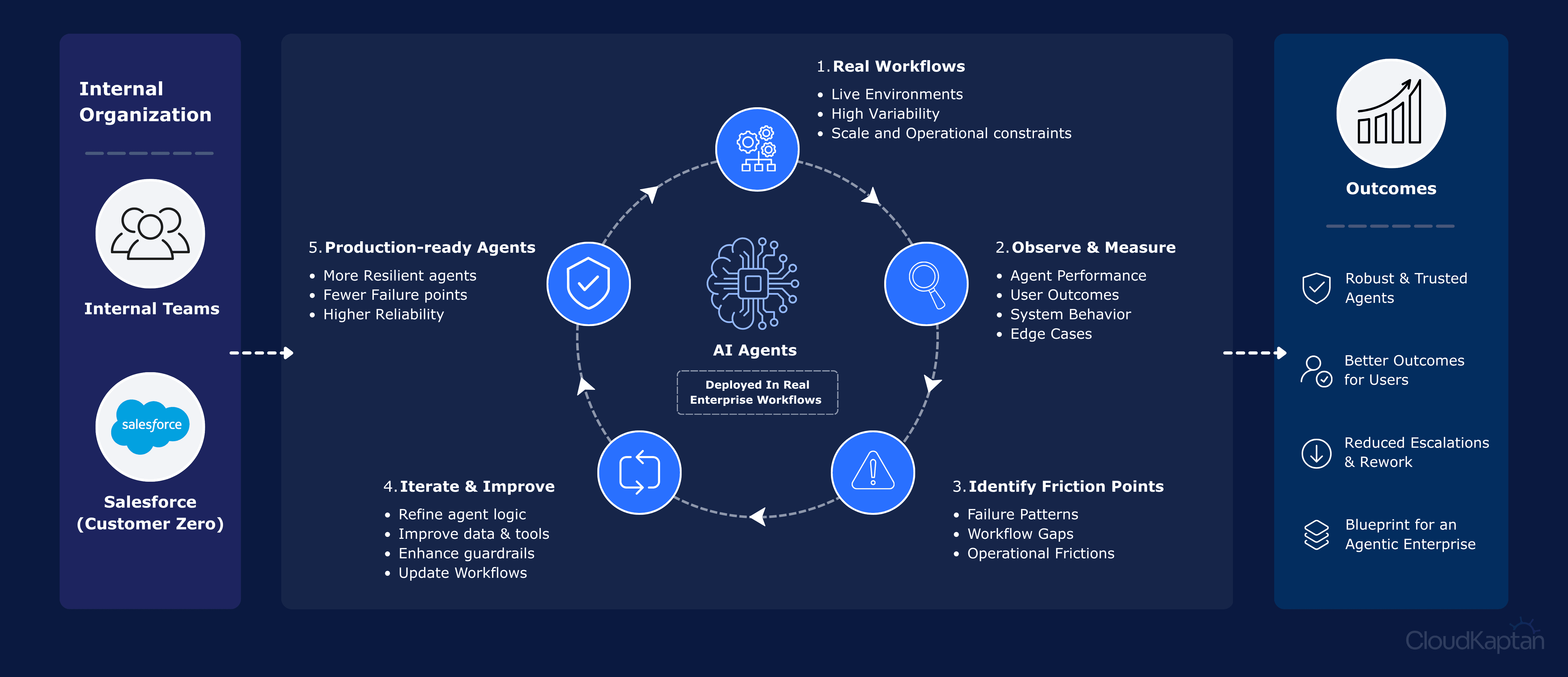
One way organisations are approaching this challenge is through what is often referred to as a Customer Zero model. This approach allows organizations to validate how AI agents behave within real workflows, where variability, scale, and operational constraints are unavoidable. Instead of optimizing for controlled scenarios, systems are tested against actual execution demands. By deploying Agentforce internally, salesforce was able to observe how AI agents perform within live workflows such as R&D risks and identify friction points in high-pressure environment. Rather than transferring the burden of iteration to customers, the organization develops a more resilient foundation in advance. Over time, this can serve as a practical blueprint for moving toward an Agentic Enterprise, where AI systems are embedded within workflows and accountable for outcomes, not just interactions.
The Operating Model of AI Agents
AI Agents introduce a fundamentally different operating model for enterprise systems. Rather than extending existing support tools or optimizing predefined workflows, it creates the conditions for a shift in the underlying model, from systems designed to manage interactions to those capable of executing and resolving work within live environments.
Traditional enterprise systems are designed to manage interactions rather than complete tasks. The core functions typically include:
Classifying incoming requests
Retrieving relevant information from internal systems
Routing requests to appropriate teams or escalating them when unresolved
These systems operate on structured assumptions, including:
Predefined logic that anticipates a limited set of user inputs
Fixed workflows that constrain how requests can be processed and resolved
These begin to break down when confronted with the complexity and variability of real-world workflows. They struggle to handle:
Multi-step tasks that require coordination across multiple actions
Changing context where user intent evolves during the course of an interaction
Cross-system actions that involve accessing and updating multiple enterprise applications
The typical outcome is predictable. Systems respond to requests, but often stop short of resolution, leaving further intervention, escalation, or manual follow-up to complete the work. AI agents, by contrast, are designed to execute tasks rather than simply manage interactions. Their capabilities typically include:
Interpreting context dynamically
Making decisions within a defined scope
Taking action across systems
Completing tasks end-to-end
The distinction becomes clearer when viewed at the level of system design. The contrast lies not in isolated features, but in how each system is structured to function.
Traditional systems are built to manage requests, while AI agents are designed to complete work. This shift from interaction to execution defines how these systems are designed, how they operate, and how their effectiveness is measured.
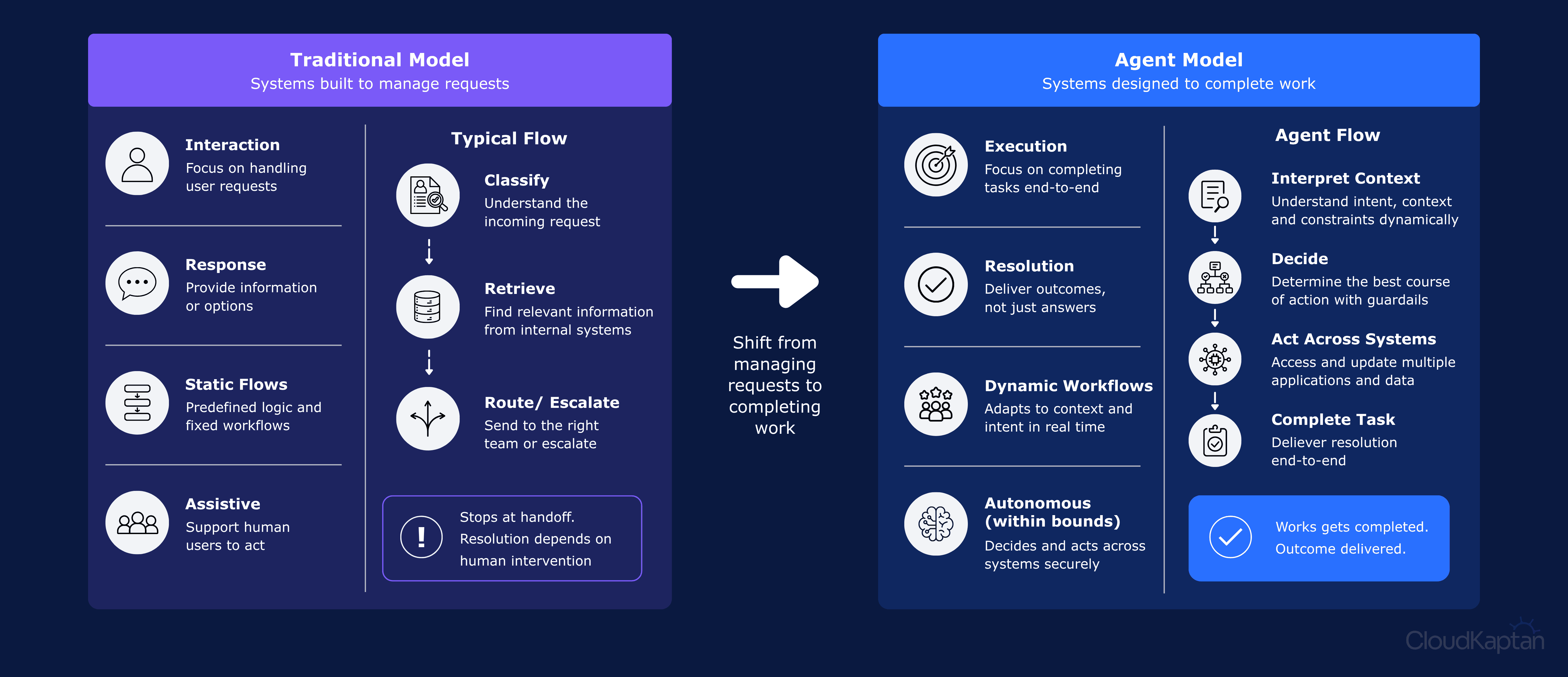
This reframing has direct implications for how support is defined and measured. The objective is no longer limited to handling tickets or managing interactions efficiently. It shifts toward completing work within the flow of operations. As a result, the effectiveness is no longer determined by how quickly a system responds, but by whether the underlying issue is resolved without further intervention.
Key Enablers of the Agentic Enterprise
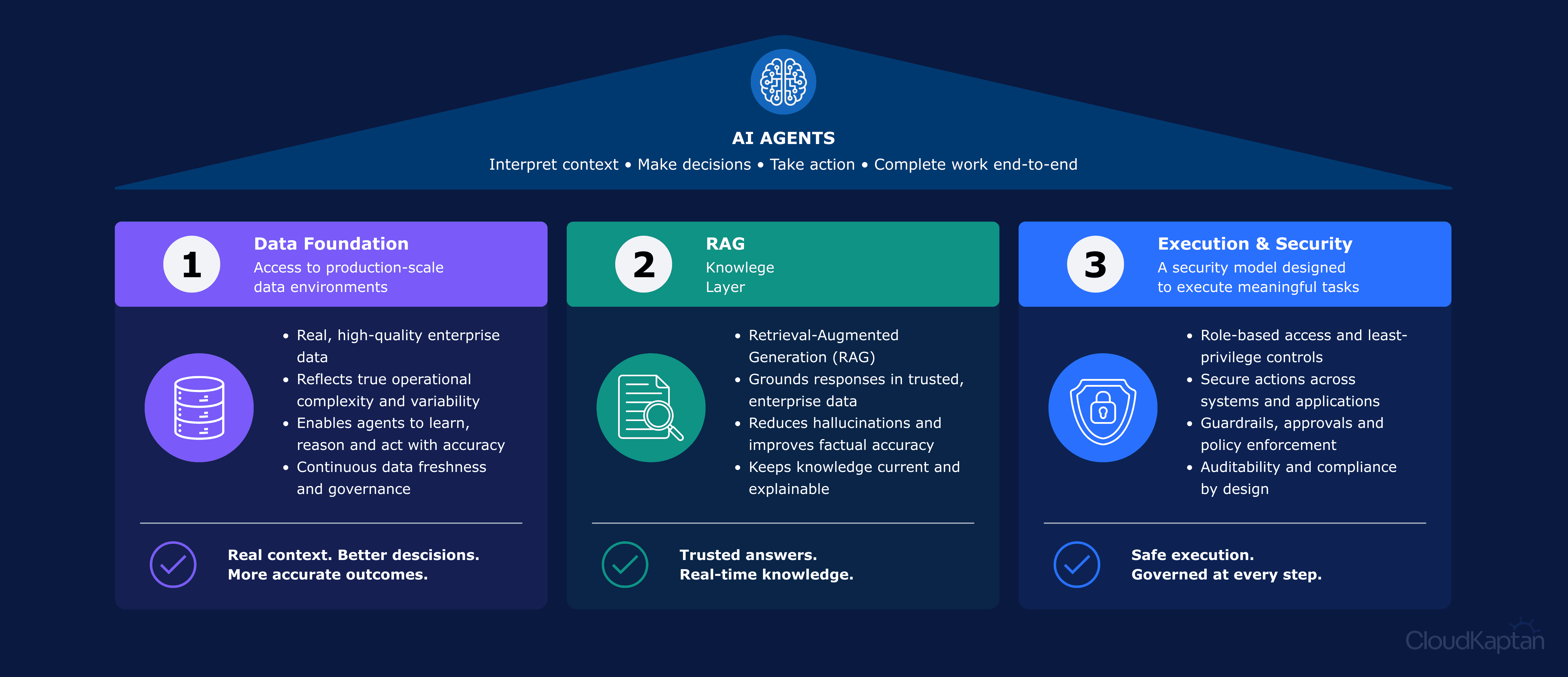
For AI agents to function reliably as execution systems, they depend on more than model capability. At scale, the reliability of such systems depends less on model capability and more on the conditions under which they are deployed.
The Key enablers include:
Access to production-scale data environments
The use of grounded response mechanisms, such as (RAG) Retrieval-Augmented Generation
A security model designed to execute meaningful tasks.
These elements ensure that systems behave consistently under real operating conditions rather than only in controlled settings. Without such a foundation, performance does not translate into reliability. The implication is that success is determined not by the model alone, but by the integrity of the surrounding system.
The Path to Agentic Enterprise
The focus is no longer on improving how systems respond, but on how they execute. In the technology industry, this transition is increasingly described as the move toward agentic systems where software is designed to operate within workflows and complete tasks with a degree of autonomy.
This has implications beyond any single use case. It begins to reshape how work is structured, how systems are designed, and how responsibilities are distributed between people and machines. These questions will be explored in greater depth in the subsequent parts of our Agentic Enterprise series.
