News
Salesforce
11 TrailblazerDX 2026 Updates Powering Salesforce's Agentic Future
Article

Arnab Mukherjee
6
min read

Trailblazer DX 2026 was packed with new features across the Salesforce platform. What comes through these updates is a shift toward making agent-driven workflows easier to integrate across existing enterprise systems. Taken together, these updates reflect what it takes to build the first generation of agentic enterprise systems in practice.
These observations from building the first generation of agentic enterprise systems help clarify what to prioritize, where complexity tends to build up, and how to stay ahead of what’s coming next.
Agentforce Script - Bringing Control to AI Agent Execution
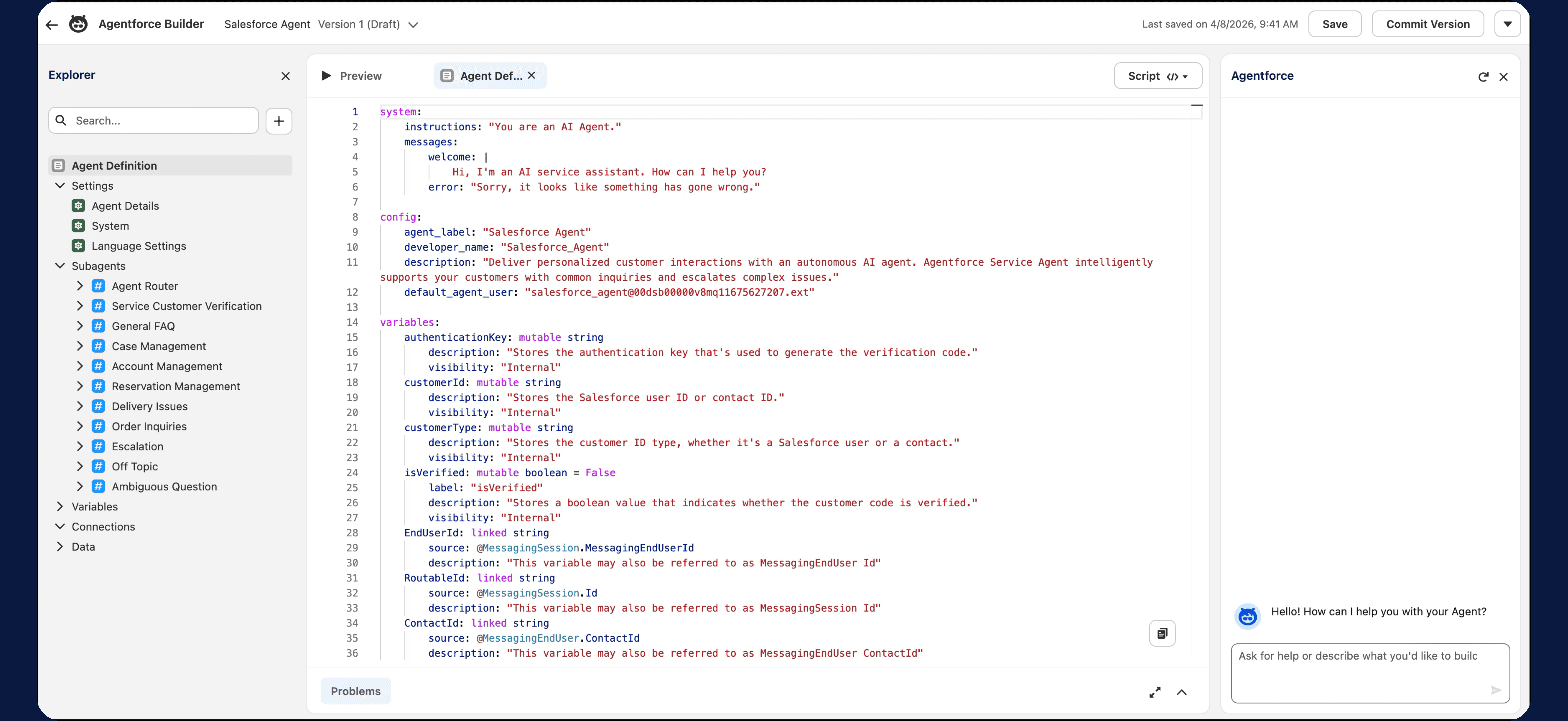
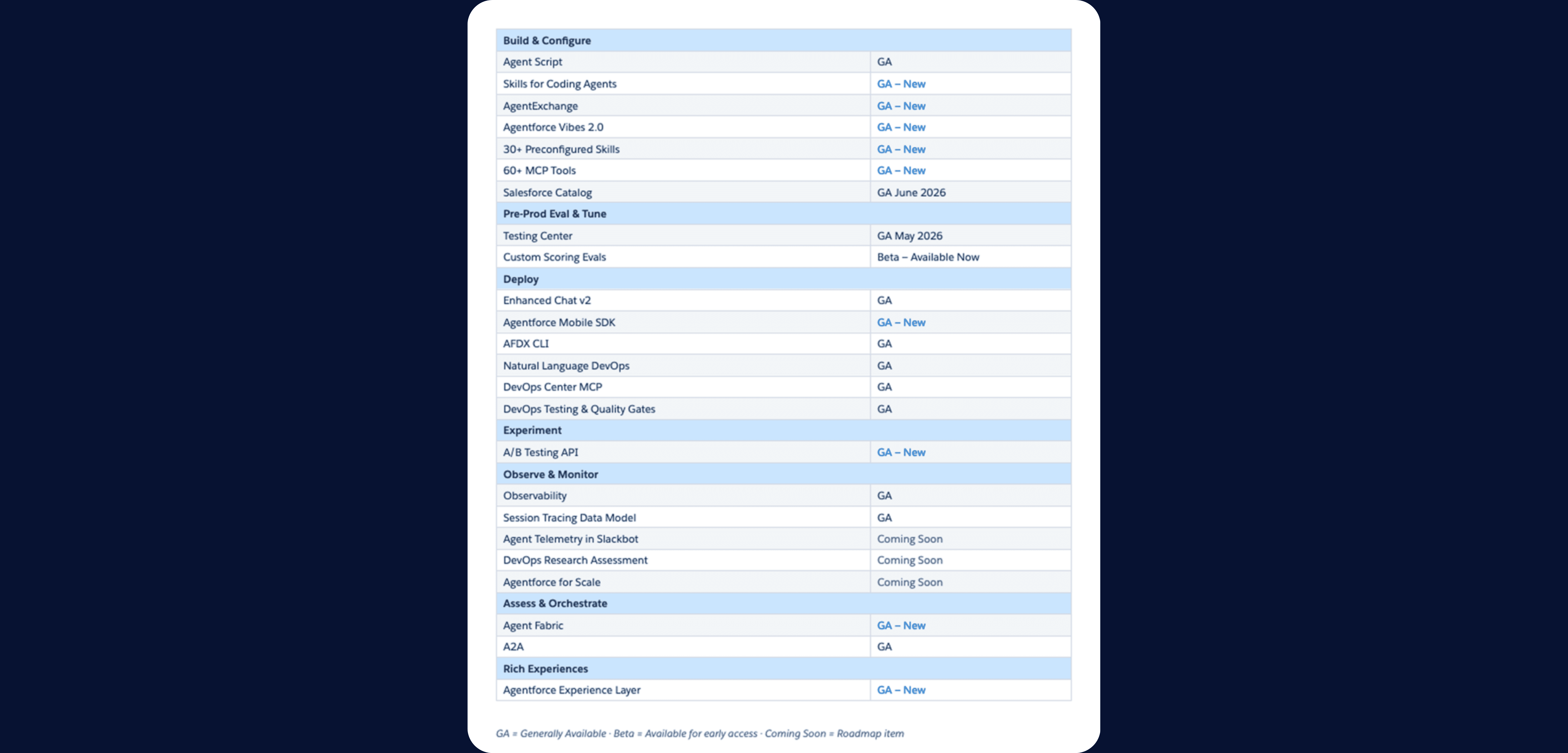
Agentforce Script is a new programmatic framework that brings determinism to AI agents. For business-critical processes like processing customer returns, handling compliance workflows, or quoting prices, that unpredictability is unacceptable. Agentforce script introduces a hybrid reasoning approach in which defining parts of agent’s workflow to follow an exact sequence and decide which parts can leverage the creative, flexible reasoning of an LLM. Outcomes become more consistent, lowering execution risk and improving trust in automated decisions. The framework also improves visibility. Teams can trace decisions, validate outputs and adjust logic without rewriting workflows. Model usage can be optimized at each stage, balancing cost and performance.
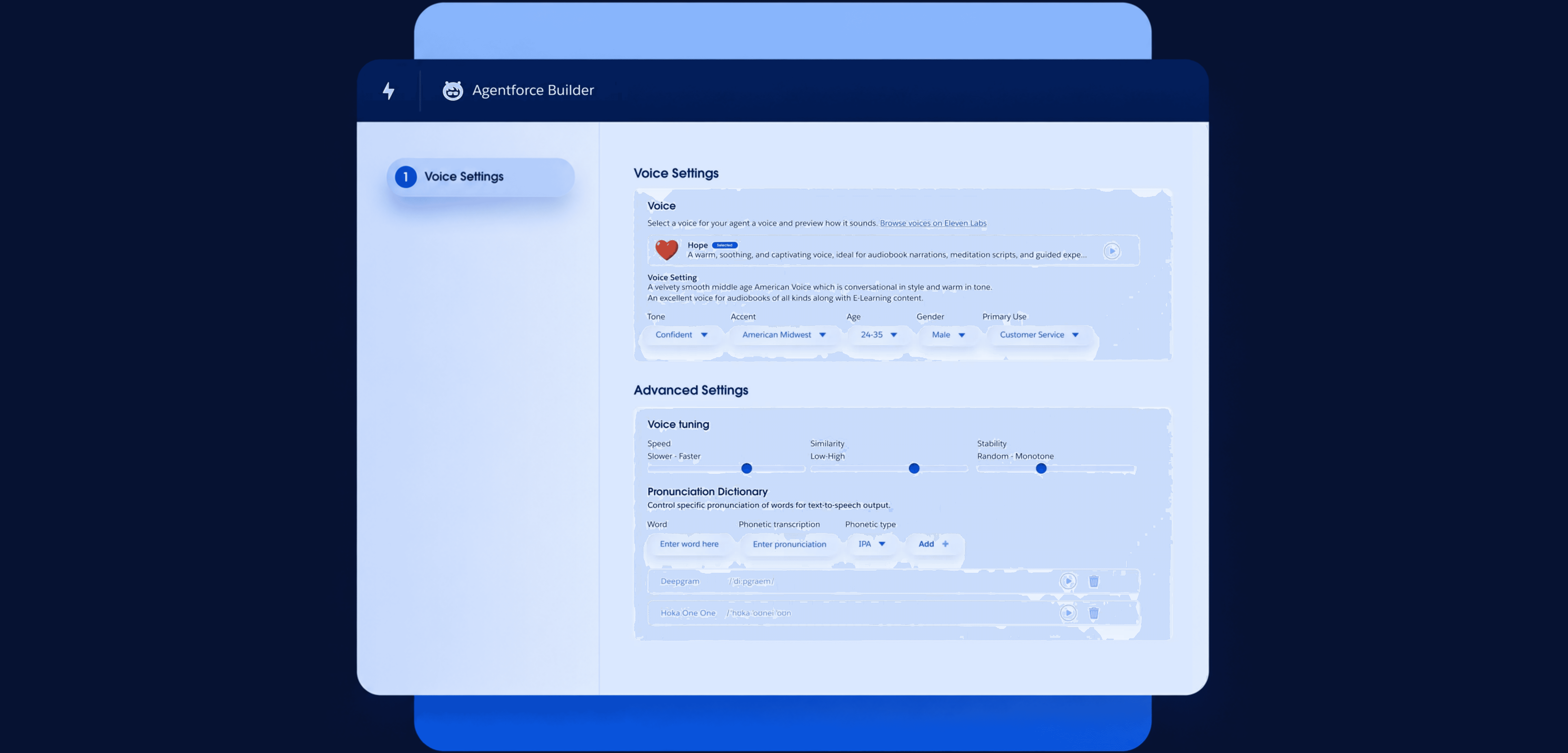
Agentforce Voice - 20+ languages Across Every Channel
Agentforce Voice has evolved from a telephony-only English feature into a multi-language voice platform that lets your AI agents speak naturally in over 20 languages across various channels like phone calls, websites, mobile apps, and WhatsApp. Salesforce has unified its voice and text runtimes into a single engine. Previously, voice agents and text agents ran on separate systems. A single agent built for text can now be deployed across voice and other channels. This reduces the cost and complexity of international customer support.
Agentforce Vibes 2.0 - AI-Powered App Building That’s 95% Faster
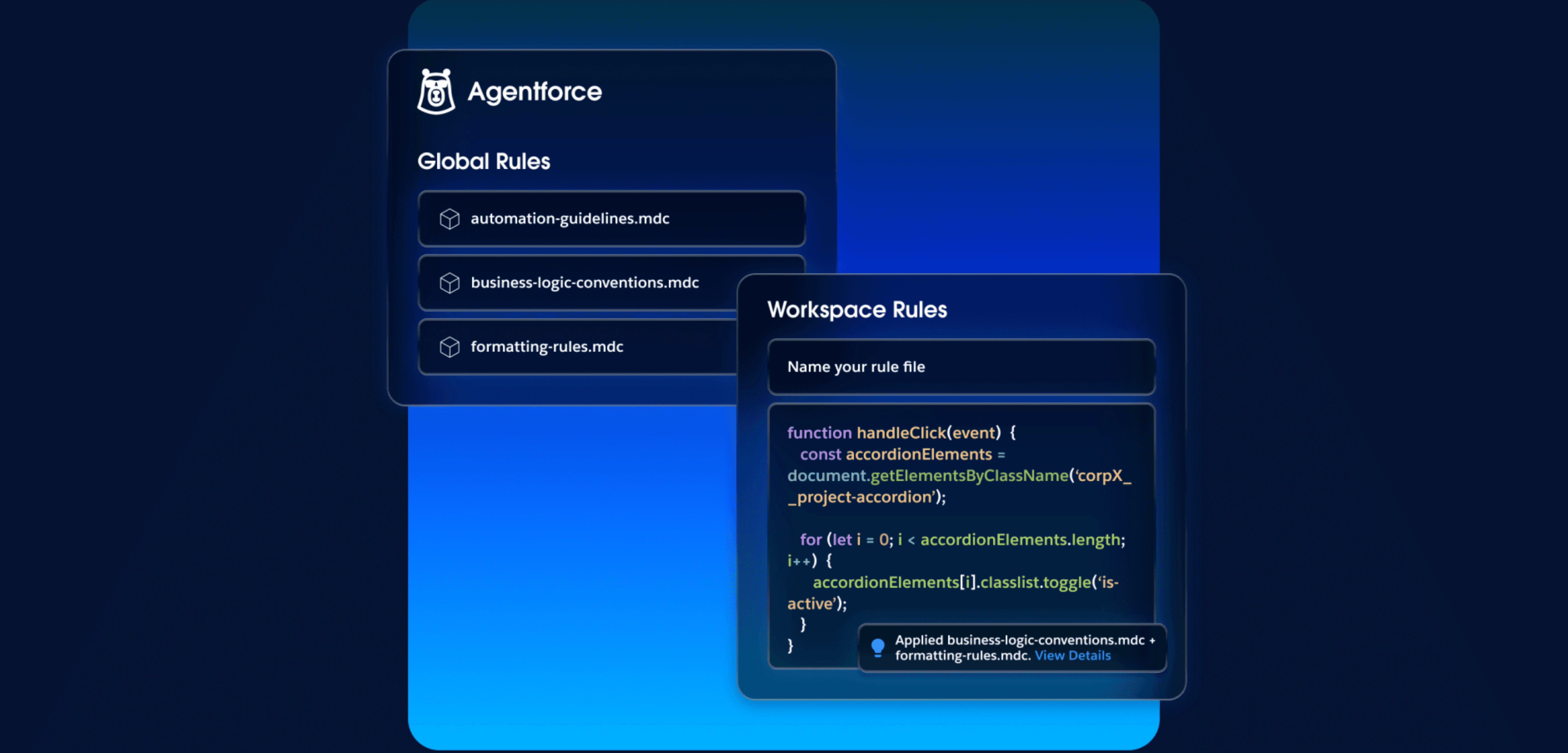
Agentforce Vibes is Salesforce’s AI-powered development environment that lets developers and admins build production-ready Salesforce applications using natural language prompts instead of manual code. It operates as a full development platform. It is provider-agnostic, allowing teams to choose models like GPT, Claude, or Codex, and metadata-grounded, reusing existing data models and permissions instead of creating duplicates. It is end-to-end, generating UI, Apex, Flows, permission sets, data models, and agent configurations within the same workflow. Development projects that used to take weeks can now be prototyped in hours. This reduces time-to-value for Salesforce investments. Development can be up to 95% faster with 97% fewer clicks.
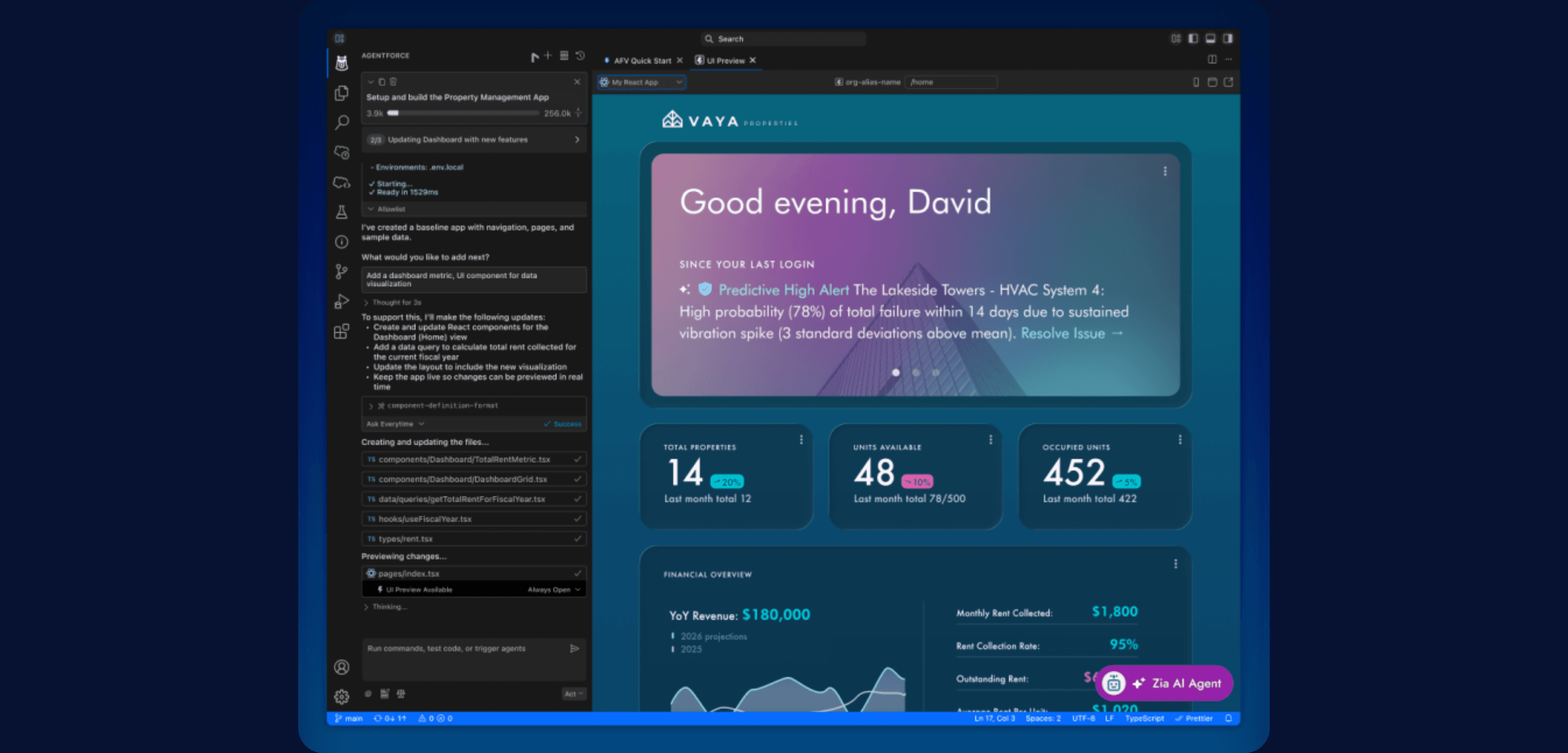
React on Salesforce - Expanding with the World’s Most Popular UI Framework, Natively
Salesforce now supports building native applications using React directly on the platform with deployment support. Developers can build authenticated and unauthenticated React apps connected to Salesforce data. Teams can tap into the global pool of React developers without relying on salesforce specific skills. The UI Bundle metadata integrates with your existing CI/CD pipeline. Local preview works without deploying to an org. And the Agentforce Vibes experience supports React generation out of the box.
MuleSoft MCP Bridge & Agent Fabric - Turn Any API into an Agent-Ready Tool
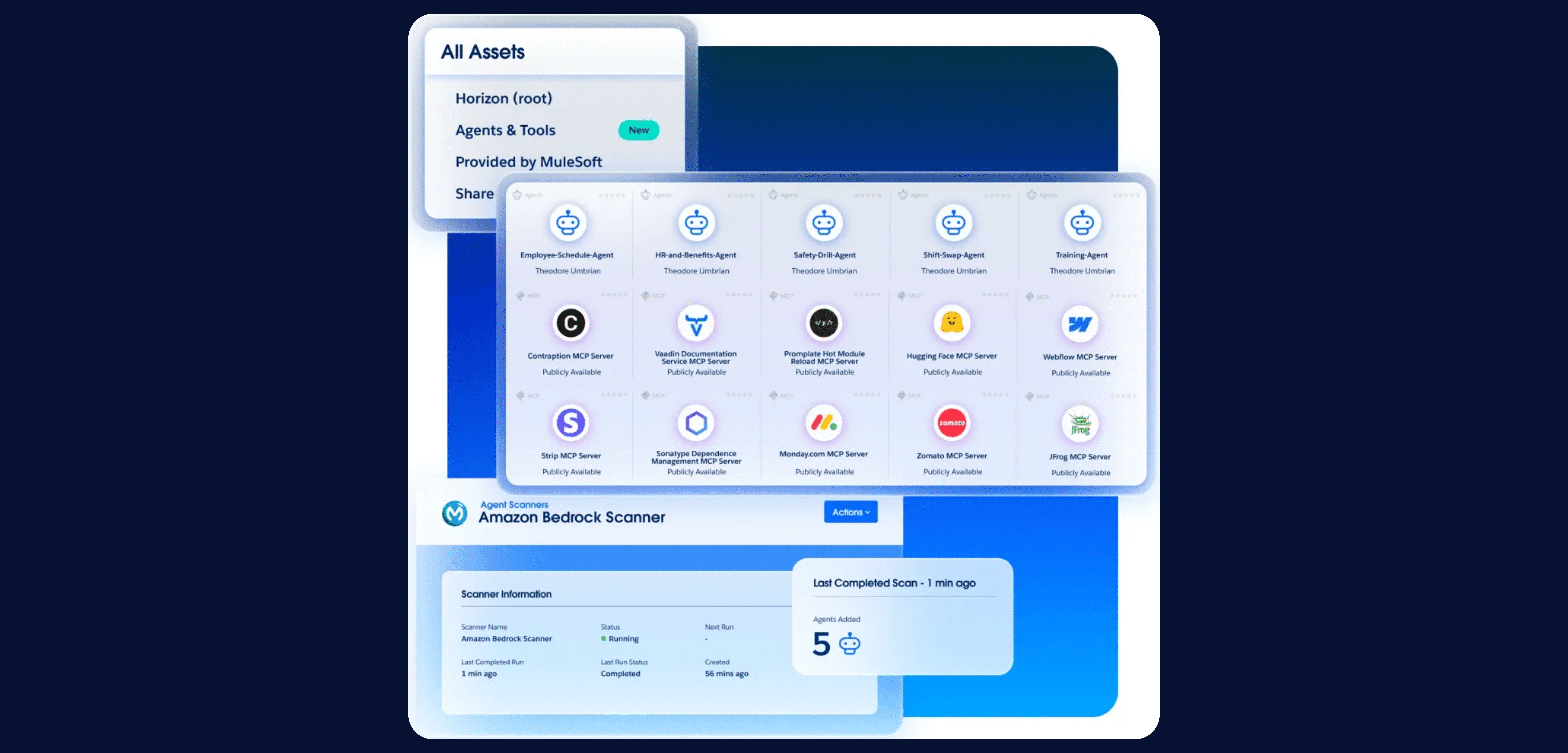
The MuleSoft MCP Bridge converts existing APIs into MCP (Model Context Protocol) servers without changing a single line of code. Agent Fabric provides centralized control plane to orchestrate agents across entire enterprise. You don’t have to rebuild your integration infrastructure for the AI era. Your existing APIs, security policies, logging, and data masking all stay intact. Agent Fabric ensures your growing portfolio of AI agents remains manageable and accountable.
Salesforce Unified Catalog - The Metadata Intelligence Layer for AI
One of the biggest challenges with AI in enterprise is ensuring the AI understands your specific business context. The Salesforce Unified Catalog creates a comprehensive, searchable layer of metadata that both humans and agents can use. It combines technical schema with business semantic knowledge. Business users and admins add semantic descriptions, glossary terms, and relationships. This transforms raw technical metadata into meaningful business context. The Unified Catalog captures your organization’s institutional knowledge and makes it available to every agent and developer. This enables AI agents to understand business terminology, data relationships, and organizational context.
AI Gateway - Bringing Control to LLM Usage at Scale
AI Gateway introduces a centralized way to manage all LLM traffic across the enterprise. It replaces fragmented usage with a single access layer, giving teams visibility, control, and consistency across models.
It is built around four capabilities:
Unified Access Layer: A single endpoint routes all requests. Developers and agents no longer manage separate API keys or isolated integrations.
Intelligent Routing: Requests are automatically directed to the right model based on complexity. Simpler tasks use lightweight models. More complex tasks use higher-capability models. This improves performance while controlling cost.
Governance & Security: Governance is applied centrally. Policies for data masking, content filtering, and usage limits are enforced across all interactions, ensuring compliance without slowing down development. Usage is fully visible.
Cost Modeling & Observability: Token consumption can be tracked across teams, agents, and use cases, giving clear insight into cost and operational impact. The result is controlled scale.
AI Gateway gives you the operational visibility and financial control necessary to scale AI adoption responsibly while also showing real-time dashboard to understand exactly how AI is being used
Web Console - The Browser-Based IDE That Lives in Your Org
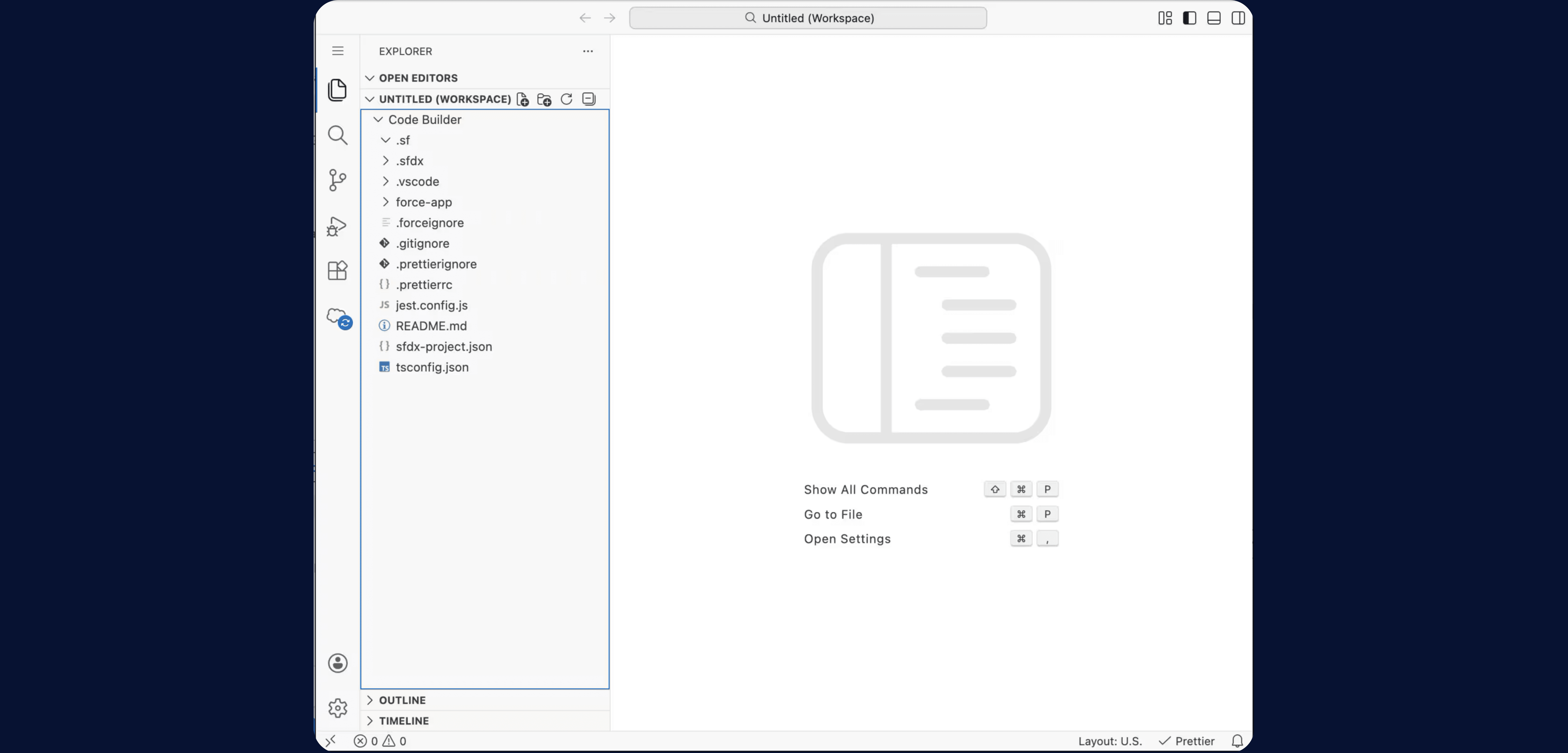
Web Console brings a browser-based development environment directly into Salesforce. It allows editing, debugging, querying, and validation within the org, without setup or local configuration. It removes the need to switch between tools. Developers can access metadata, inspect logs, run queries, execute Apex, and deploy changes from a single interface. Everything stays connected to the live environment. This is especially effective for real-time issue resolution. Problems in production can be investigated and fixed immediately, without setting up projects or managing authentication. The result is faster debugging, reduced downtime, and quicker turnaround on critical fixes.
Headless 360 - Building for APIs and Agents from the Start
Headless 360 establishes a model where all Salesforce capabilities are exposed through APIs, CLIs, and Skills from the start. Development is no longer centred around the UI. It becomes one of several consumption layers. This enables direct integration across systems. Features can be accessed programmatically, automated through agents, and connected to external tools without dependency on the interface. The approach improves how systems are built and operated. APIs support integration and automation. CLI-based workflows align with DevOps and CI/CD pipelines. Skills act as reusable building blocks that can be applied across agents, applications, and platforms. The result is a more flexible architecture. Systems become easier to integrate, automate, and scale, with consistent access across users, agents, and external services.
Agentforce testing centre 2.0 - Confidence Before Deployment
Testing Centre 2.0 introduces an automated framework to evaluate AI agents before production. It supports assertion-based evaluations to verify execution paths, LLM-as-a-judge scoring to assess response quality, and custom evaluators aligned to business requirements such as safety, compliance, and brand voice.
It enables testing across multi-turn and voice interactions, along with regression testing at scale to detect performance drift across versions. Test execution is integrated directly into the Agentforce Builder, with session traces linked to failures for faster debugging. This reduces reliance on manual SME validation and brings structure to how non-deterministic systems are tested. The result is higher confidence at deployment, faster iteration cycles, and reduced operational and brand risk.
Flow Evolution - Expanding Automation and Orchestration
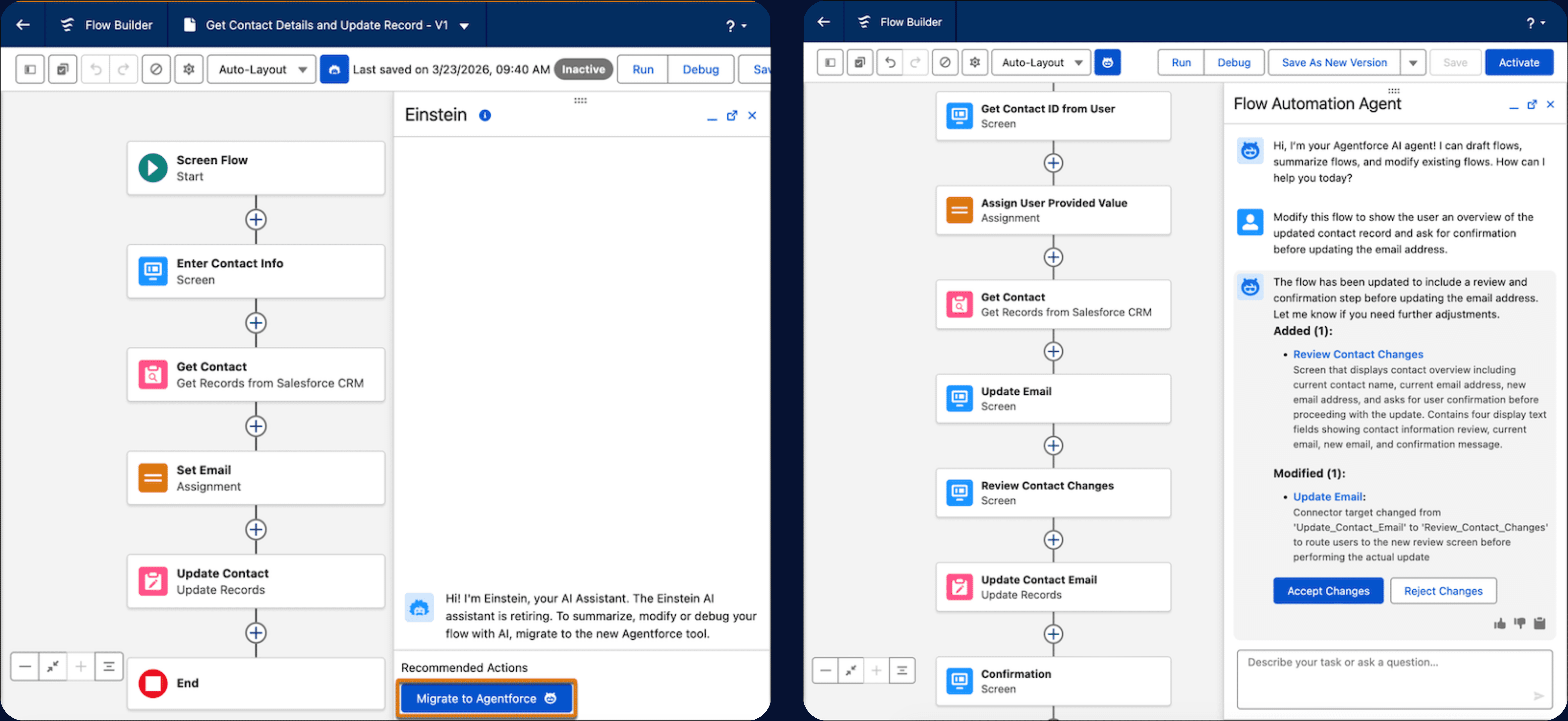
Flow introduces a set of enhancements that expand how automation is built and operated across Salesforce. Orchestration is now available without additional licensing, enabling coordination of multi-step processes, parallel approvals, and cross-functional workflows without added cost. Flows can now be triggered by file activity. Uploads, updates, or changes to documents can directly initiate workflows. This is critical for document-driven processes such as contracts, approvals, and compliance operations.
AI-powered editing allows flows to be modified using natural language. Logic can be created or updated by describing the requirement, reducing manual effort and accelerating iteration. Decision elements can also evaluate unstructured inputs such as sentiment, enabling more context-aware automation. Additional enhancements include version comparison for change management, improved debugging with persistent inputs, orchestration-level debugging, and flow logs via Data 360 for performance tracking. The result is more accessible automation, faster iteration, and stronger control over complex business processes.
What’s Next
Agentic systems are moving from experimentation to real business operations. As agents begin to handle workflows, decisions, and interactions across systems, the expectation is shifting toward reliability, control, and integration at scale.
Salesforce is aligning its platform to support this shift. The updates across TrailblazerDX 2026 reflect a move toward more structured, observable, and deployable agentic systems across enterprise environments.
To support this shift, the focus is on building the underlying systems that make agentic workflows reliable in practice. This includes designing agent-driven architectures, integrating enterprise APIs through MCP and headless frameworks, and establishing governance layers for model usage, data access, and decision traceability.
There is also increasing emphasis on real-time system orchestration, structured testing for non-deterministic workflows and enabling consistent execution across channels and environments. As these systems expand, the need for scalable integration patterns and operational visibility continues to grow.
To explore how these capabilities are being implemented across Salesforce, connect with our team at CloudKaptan.
