Artificial Intelligence
Data
Agentic Commerce in 2026: When the Customer is a Moving Target
Article

CK Editorial Team
5
min read

For decades, commerce has been built around a single assumption: human decision. Every website, loyalty programme, and checkout flow was designed for one decision-maker, standing at the end of a journey, choosing to buy. That assumption has already broken once — AI agents now research, compare, and increasingly transact on a person's behalf. It will break again if businesses still design for targets "the AI agent as customer" that are already halfway to moving.
The Numbers Behind Autonomous Agentic Commerce
The scale of this shift is not speculative. It is already showing up in market data and consumer behaviour alike.
The US agentic commerce market could reach $300–500 billion by 2030, representing 15–25% of total e-commerce.
30–45% of US consumers already use gen AI for product research and comparison.
74% of consumers say they would trust a personal AI agent more than their best friend to make a purchase on their behalf.
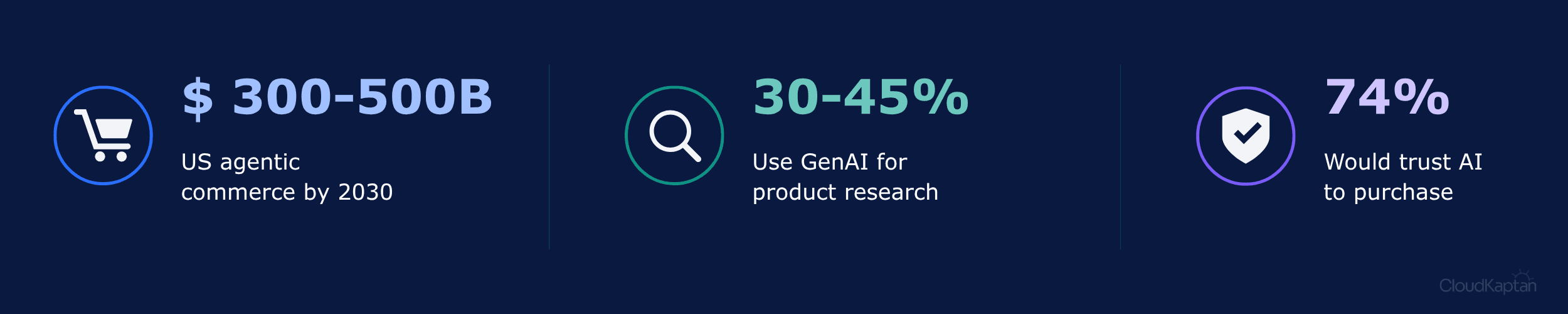
Together, these figures describe a shift that is no longer approaching — it is under way. The infrastructure, the trust, and the consumer behaviour are converging at the same time, which is precisely why the target keeps moving rather than settling.
Where AI Agents Are Moving Into Commerce
At its core, agentic commerce follows a five-stage workflow: intent, curation, negotiation, payment, and proactive care. Underneath this sits a hierarchical architecture — a manager agent that coordinates specialised sub-agents, each scoped to a single task, one for negotiation, another for payment execution, another for post-purchase support.
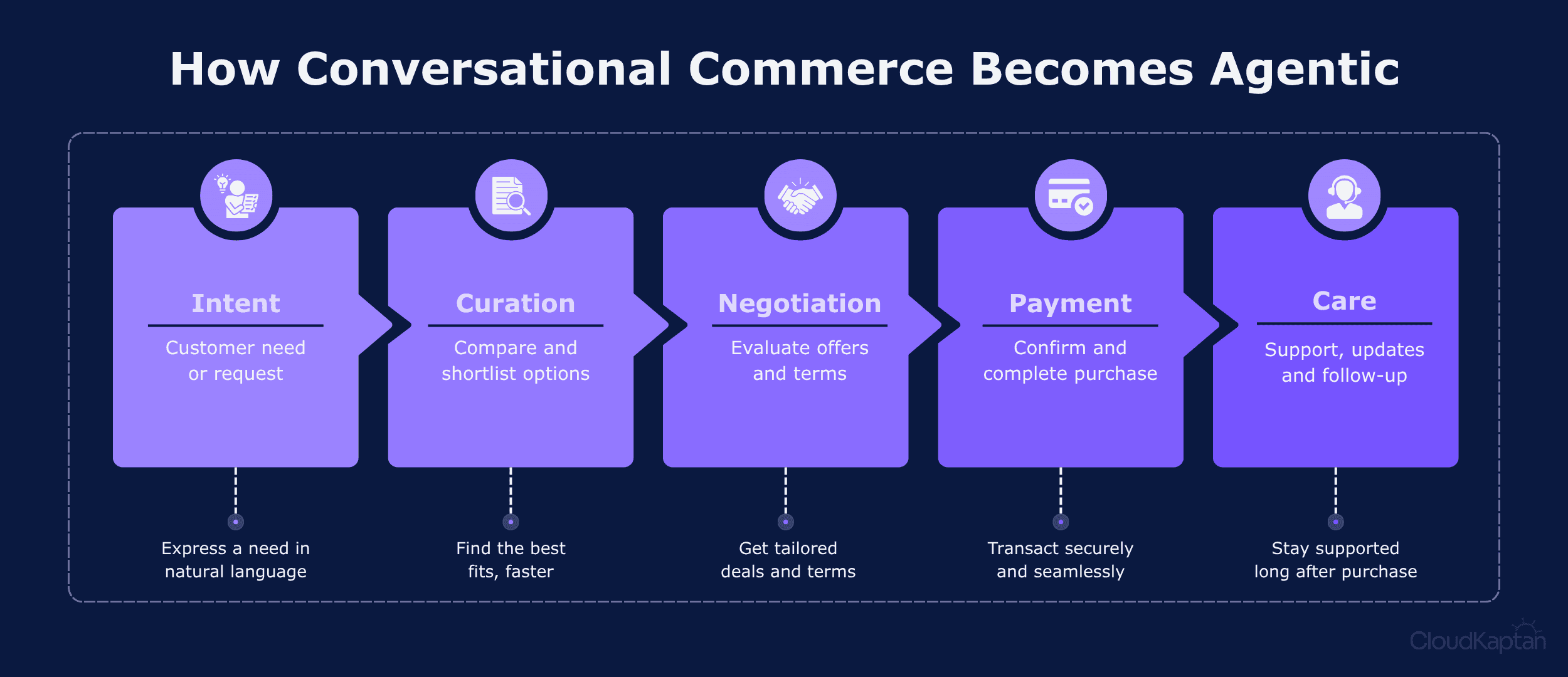
This structure is enabled by four technologies reaching maturity together: large language model APIs, programmable payment rails, and emerging trust and identity layers. None of this is exotic any longer; it is becoming the default architecture across the industry.
Will Today's Agent-Ready Strategy Survive Tomorrow?
Most businesses preparing for agentic commerce are preparing for a single moment: a consumer's AI agent, negotiating on that consumer's behalf. This is already reshaping loyalty, 37% of behaviourally loyal consumers say they would let an AI agent switch them away from a preferred brand for a better fit. This number should question the value that’ll be created and what brand strategy to be built on human habit.
But it is only the first shift. In the near term(roughly the next 2yrs) — agents are moving into procurement and supply-chain functions, transacting on a business's behalf rather than a consumer's. Whereas in the medium term, the shift compounds further: autonomous buyer agents negotiating directly with autonomous seller agents, with no human, and potentially no single agent, present in the loop at all. Who is liable when two autonomous systems agree a bad deal, or when an agent mis-executes a transaction, remains an open question: one bodies such as the Cloud Security Alliance are only beginning to formalise through emerging trust frameworks.
Businesses that finish building for ‘AI agent as customer’ and stop there will find themselves exactly where legacy-bound enterprises found themselves with integration: correctly scoped for a target that has already relocated.
A Readiness Framework for Agentic Operations
Rather than a single readiness checklist, the more durable approach is a staged model one built to be revisited as the definition of "customer" keeps shifting.
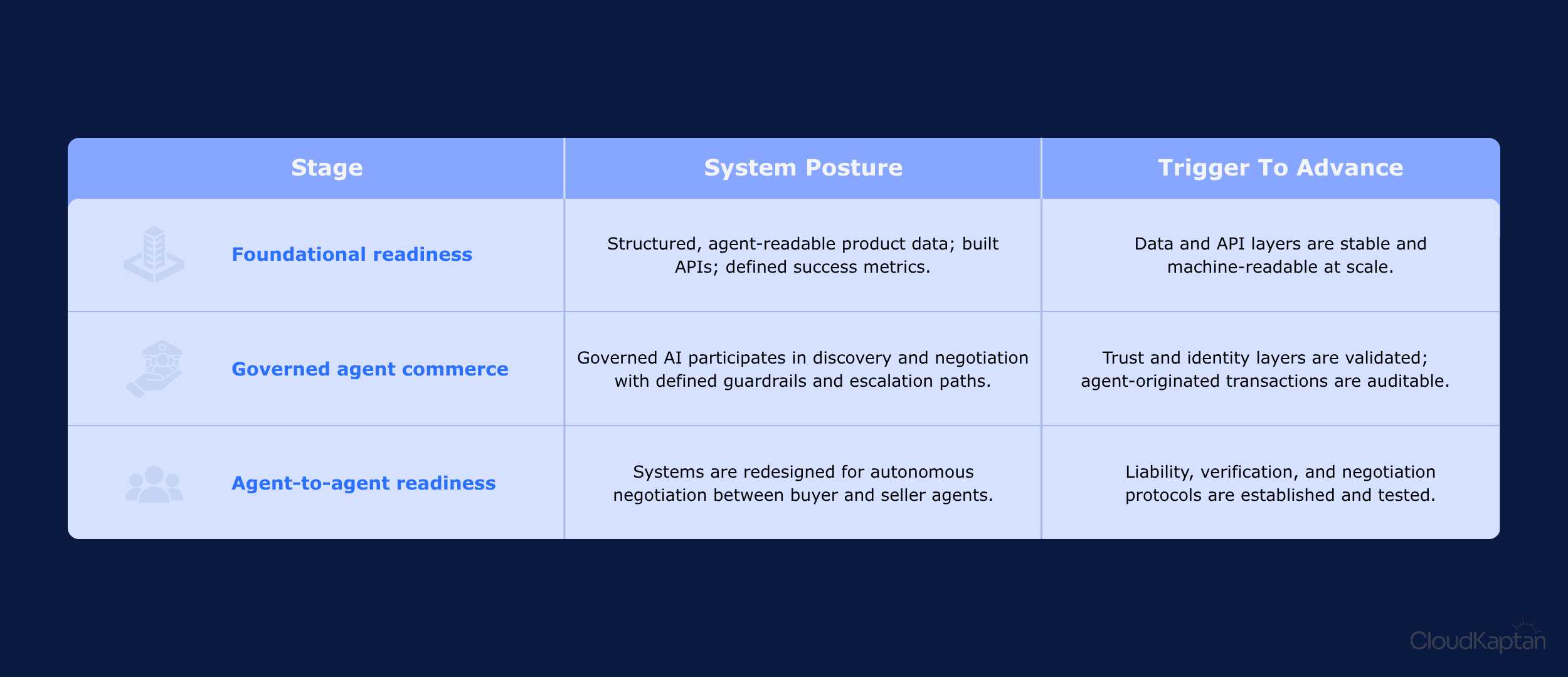
As in integration, the trigger column carries the weight here, not the stage names. A business that reaches Stage 1 and stops has built for today's agent, not the negotiating agent-to-agent economy already forming behind it.
Getting Agent-Ready in Practice
In practice, this starts with product and pricing data restructured for machine legibility, not just human browsing, alongside APIs that expose real-time inventory, pricing, and fulfilment status to external agents under clear governance. Negotiation logic is then layered in with defined boundaries, discount limits, bundling rules, exception triggers, rather than left to open-ended agent discretion. None of this is a one-time build. As agent capability advances from single-agent negotiation toward agent-to-agent exchange, the same architecture has to absorb new verification and liability requirements without a rebuild. This is where the work increasingly resembles infrastructure partnership rather than a single project: systems maintained continuously, in step with how quickly the definition of "customer" keeps changing.
Next Steps for Autonomous Agentic Commerce
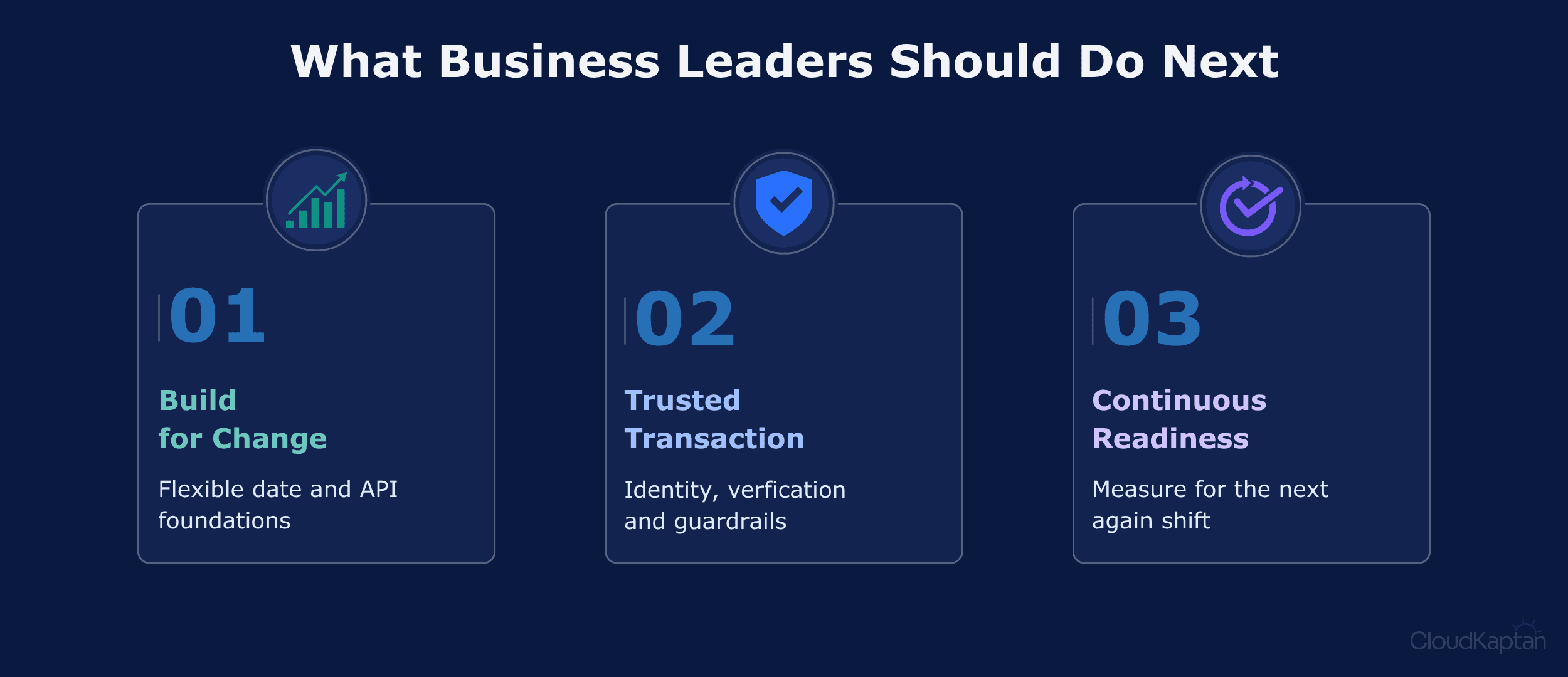
Treating agentic commerce as a moving target rather than a single transition carries three practical implications.
Design for successive customers, not one. The single AI agent negotiating on a consumer's behalf is not the finish line build data and API layers flexible enough to serve the next configuration too.
Treat trust infrastructure as core, not optional. Verification, identity, and liability frameworks are still forming; businesses that wait for them to mature fully will be building against consensus that has already moved on.
Measure agent readiness continuously. The relevant question is never whether if we are we agent-ready, but ‘are we ready for the agent configuration coming next.’
The businesses still optimising for a single AI agent as their customer are building for a relationship that is already evolving past them.
