Artificial Intelligence
AI to ROI in 2026: The Gap Between Enterprise Pilots and Production
Article

CK Editorial Team
5
min read

95% of generative AI pilots deliver no measurable return, according to MIT research, 2025. The figure has been repeated so often that it has lost its edge, cited as proof that artificial intelligence overpromises and underdelivers. Where another reading suggests something narrower and more useful: most enterprises were not solving the wrong problem. They were solving the right problem for a target that had already moved.
The Numbers Behind the Enterprise AI Failure
The pattern is structural, and it shows up consistently across independent sources.
95% of enterprise generative AI pilots show zero measurable P&L impact, against 5% that scale successfully.
40% of IT budgets go toward maintaining technical debt, leaving a fraction for genuine modernisation.
60% of AI leaders name legacy-system integration as the primary barrier to Agentic AI adoption.
10–20% of budget earmarked for new development is redirected to legacy firefighting each year.
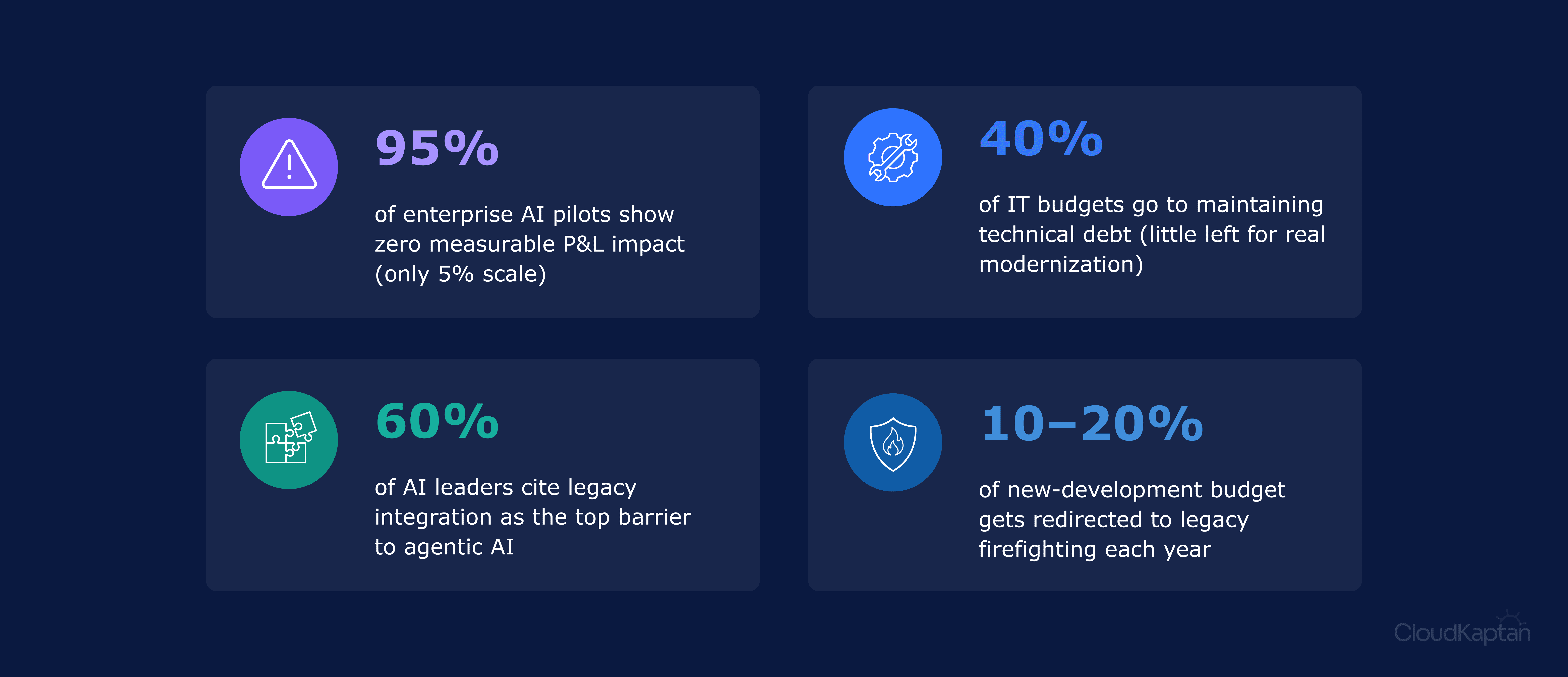
Together, these figures describe an enterprise that is perpetually funding its own past. Capital intended for the next architecture is conscripted to defend the current one, a divide in absorption capacity, not ambition.
Why Standard AI Integration Falls Short
The prevailing playbook for legacy-AI integration follows three steps: an API layer abstracts the mainframe, a data fabric gives siloed records shared context, and a read-only assistant is deployed last, write access withheld until reliability is proven. Each stage is technically sound.
What it misses is time. Most integration playbooks are calibrated to a single moment of AI capability — the assistant that observes and suggests. That is where the current generation of pilots is built to stop, and it is a meaningful reason they succeed narrowly and then stall. The playbook assumes that once the wrapper ships, the work is complete. Budget moves elsewhere. The architecture is declared finished.
That assumption does not hold once agentic systems enter the picture.
Why AI Adoption Chases a Moving-Target?
Let’s consider the trajectory, just few months ago, ‘AI integration’ meant a chatbot retrieving answers from a knowledge base. Today it increasingly means an agent initiating action: updating a record, triggering a downstream process, executing several steps with only intermittent human review. Each jump in capability changes what the legacy estate is asked to tolerate: deeper write access, tighter governance, lower latency, richer semantic context.
The integration layer built for a read-only assistant was never designed for write-capable autonomy. It was correctly scoped at the time since then the target has since relocated.
This is the more precise explanation for what practitioners call ‘pilot fatigue’ — rarely one failed initiative, more often a sequence in which each pilot clears the bar set for its moment, and each success quietly resets that bar for the one after it. An organisation that treats integration as a completed milestone is, almost by construction, one capability cycle behind by the time it declares victory. The enterprises pulling ahead are not building better first architectures. They are building for re-entry.
A Framework for Enterprise AI Governance
If the target moves, the model built to reach it should be designed for repeated arrival, not a single approach. The following staged framework treats each level of legacy-AI integration as a checkpoint to be reassessed, rather than a milestone to be closed out.
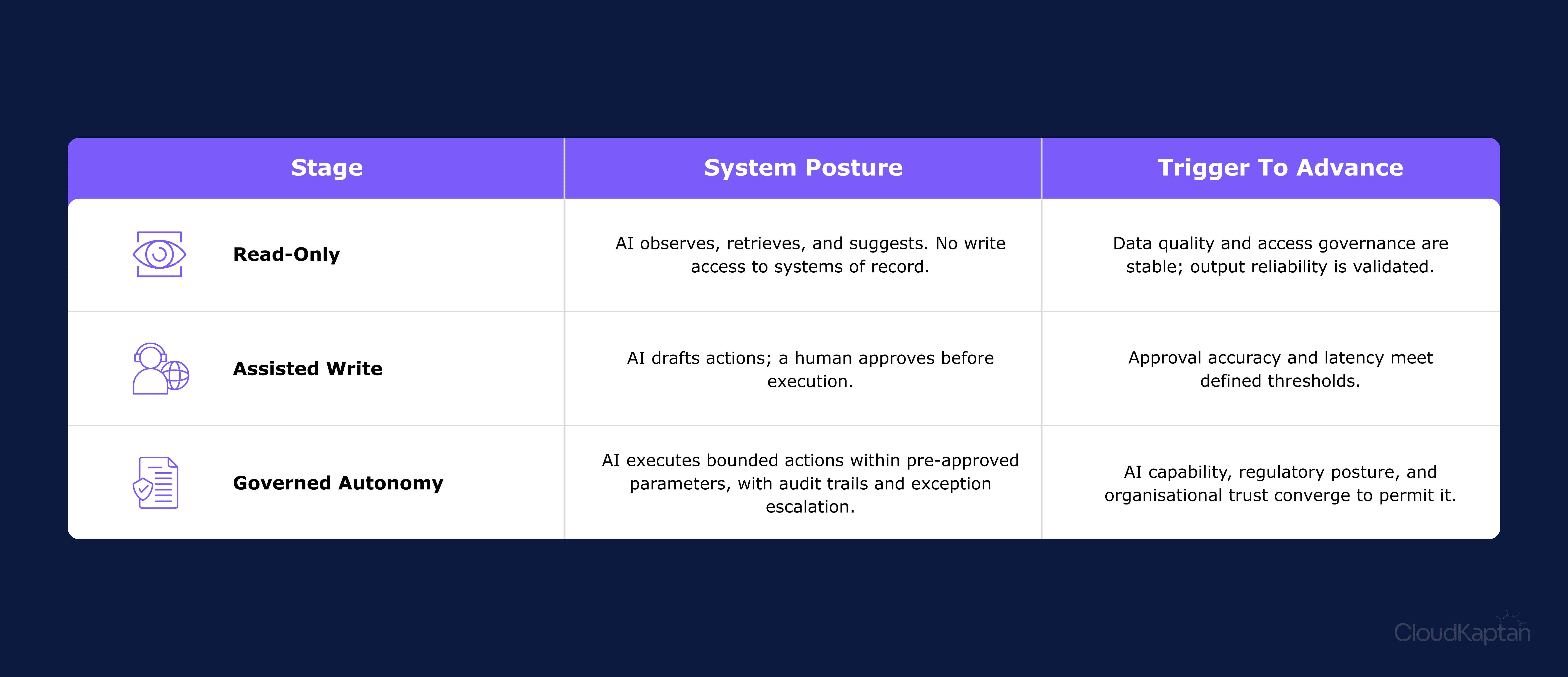
The distinguishing feature of this model is the ‘trigger’ column, and not the stage names. Each transition is tied to a measurable shift in capability and readiness, rather than a date or any executive mandate. This is what separates a maturity model from a project plan: a project plan ends. This does not; it is reviewed, stage by stage, as agentic capability advances.
What Re-Architecting Looks Like in Practice
Applied to a real environment, the framework changes how the underlying architecture is built, not just how it is described.
A core system: a ledger, a claims engine, an ERP that stays untouched at first. An API gateway sits in front of it.
Stage one begins narrow: a read-only assistant, perhaps for fraud detection or document retrieval, with no write permissions.
As capability and confidence grow, write-back access is introduced for defined exception cases only, gated by identity-aware controls.
Audit logging and escalation paths are built at this point, not retrofitted later under regulatory or operational pressure.
Each stage is versioned, not final where the architecture is expected to absorb the next capability jump without a rebuild.
This sequence maps directly onto the framework outlined above: the transition from Stage 1 to Stage 2. It is the trigger validated reliability, defined approval thresholds that determines the timing of that transition. Architecture designed for this kind of staged progression is, by necessity, maintained as a continuous function rather than delivered as a single, time-bound project.
What Leaders Should do Next
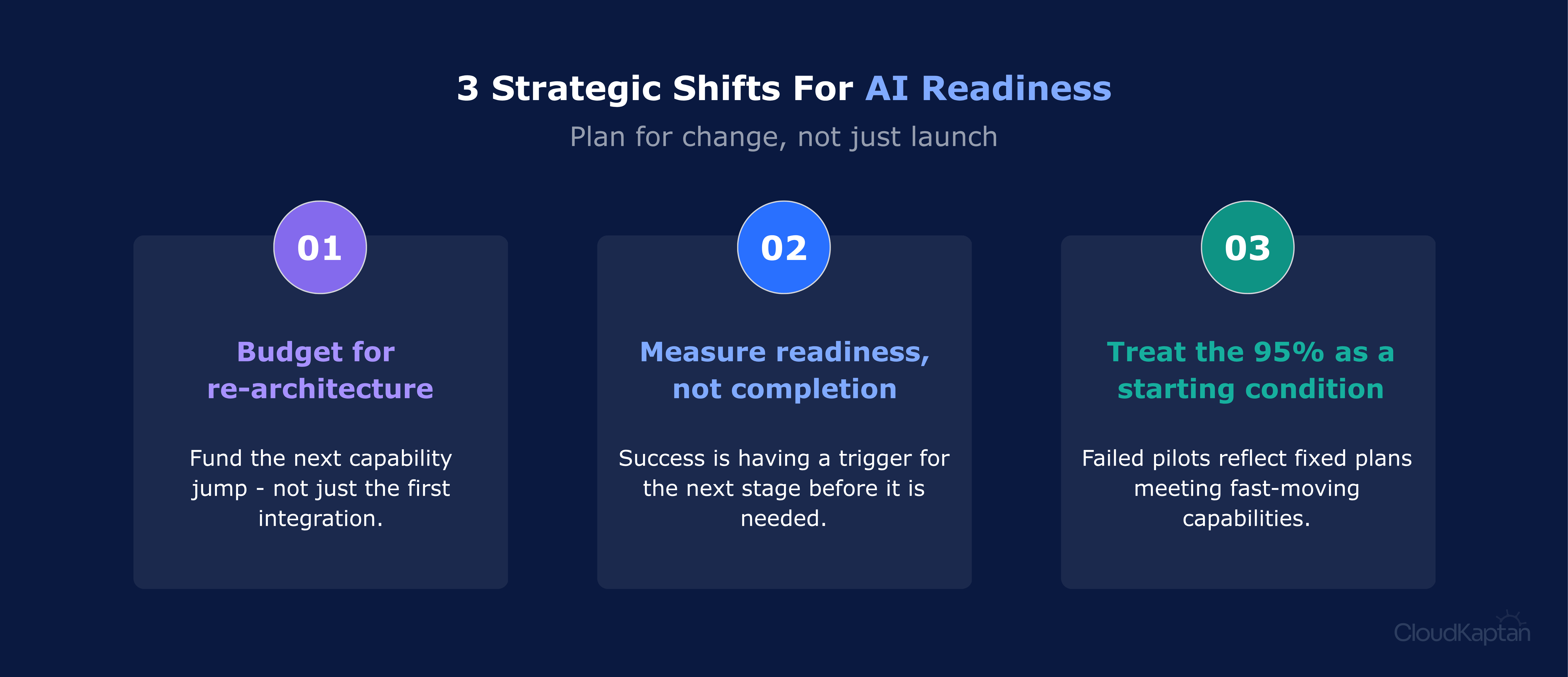
Treating integration as a moving target rather than a fixed milestone carries three practical implications for how enterprises plan, fund, and evaluate their AI initiatives:
Budget for re-architecture, not just architecture. A one-time integration line item will underfund the second and third capability jumps that are already on the way.
Measure readiness, not completion. Success is not "the wrapper shipped." It is whether the organisation has a defined trigger for its next stage before that stage is required.
Treat the 95% as a starting condition, not a verdict. The pilots that fail are not a judgment on AI's usefulness — they are what happens when a fixed plan meets a capability curve that does not hold still.
The enterprises still measuring success against the original finish line have already fallen behind the one that moved.
