Databricks
Artificial Intelligence
The Rise of Agentic Customer Intelligence
Article

CK Editorial Team
7
min read

For years, the enterprise lakehouse was treated largely as a reporting backbone, a place where organisations could bring data together, run analytics and improve visibility. But as AI agents begin to move closer to business workflows, that role is quietly expanding.
The question is no longer whether enterprises have enough customer data. Most already do. The harder question is whether that data is trusted, connected and meaningful enough for AI systems to act on it.
This is where customer intelligence is entering a new phase. Traditional CDPs helped organisations unify profiles and segment audiences. AI-led engagement demands something more: a foundation where customer data, identity, context, governance and activation work together.
The Lakehouse Is Moving Beyond Reporting
The lakehouse began as a practical answer to a long-standing enterprise problem: data was scattered, duplicated and difficult to use at scale. By bringing structured and unstructured data into one governed environment, it gave organisations a stronger foundation for analytics, reporting and business intelligence.
It is no longer enough to store clean data for dashboards. The platform must connect insights from across the data estate and business tools, so AI can move from answering questions to supporting action across systems such as CRM, collaboration platforms, documents and operational workflows.
This shift matters because reporting shows a business what has happened. AI-led engagement needs to understand what is happening now, in real time and what action should follow. It is becoming the place where data can be prepared, governed and activated for intelligent action.
Why AI Agents Need More Than Data Access
AI agents are often discussed as though access to enterprise data is the main breakthrough. But access alone does not make an agent intelligent, useful or safe.
The harder problem is context. In most enterprises, the business context an AI agent needs is scattered across dashboards, queries, pipelines, documents, tickets, wikis and conversations. When the agent cannot find that context, it may fill the gap through inference, producing answers that are generic at best and wrong at worst.
A customer record may show transactions, complaints, renewals and campaign history. Yet the agent can still misread the situation if data is divided across systems, identity matches are uncertain or teams define the same metric differently. A technically valid query does not guarantee a correct business interpretation.
Agents therefore need identity resolution, governed definitions, consent controls, behavioural signals to both structured and unstructured data from customer tables and campaign history to service notes, complaint, call transcripts, emails and knowledge sources. Otherwise, they may see the customer profile but miss the customer reality.
Customer Intelligence Is Where the Shift Becomes Visible
The value of agentic AI becomes clearest in customer intelligence because customer engagement is no longer built on static segments alone. It depends on timing, behaviour, intent, history and context.
The point is not that enterprises need more personalisation They need better intelligence behind it. Segment-based personalisation can tell a business who to target. Contextual customer intelligence can help explain why the moment matters, what the customer may need next and which action is appropriate across sales, service or marketing.
Customer Profile to Closed-Loop Decisioning
The deeper shift is from customer profiles to closed-loop customer decisioning. In a traditional model, behavioral data is collected, analysed and later used to create a segment or campaign. In an agentic model, live signals update the customer’s current state, an AI agent interprets intent, retrieves the relevant business context, recommends or executes an approved action and then observes the outcome.
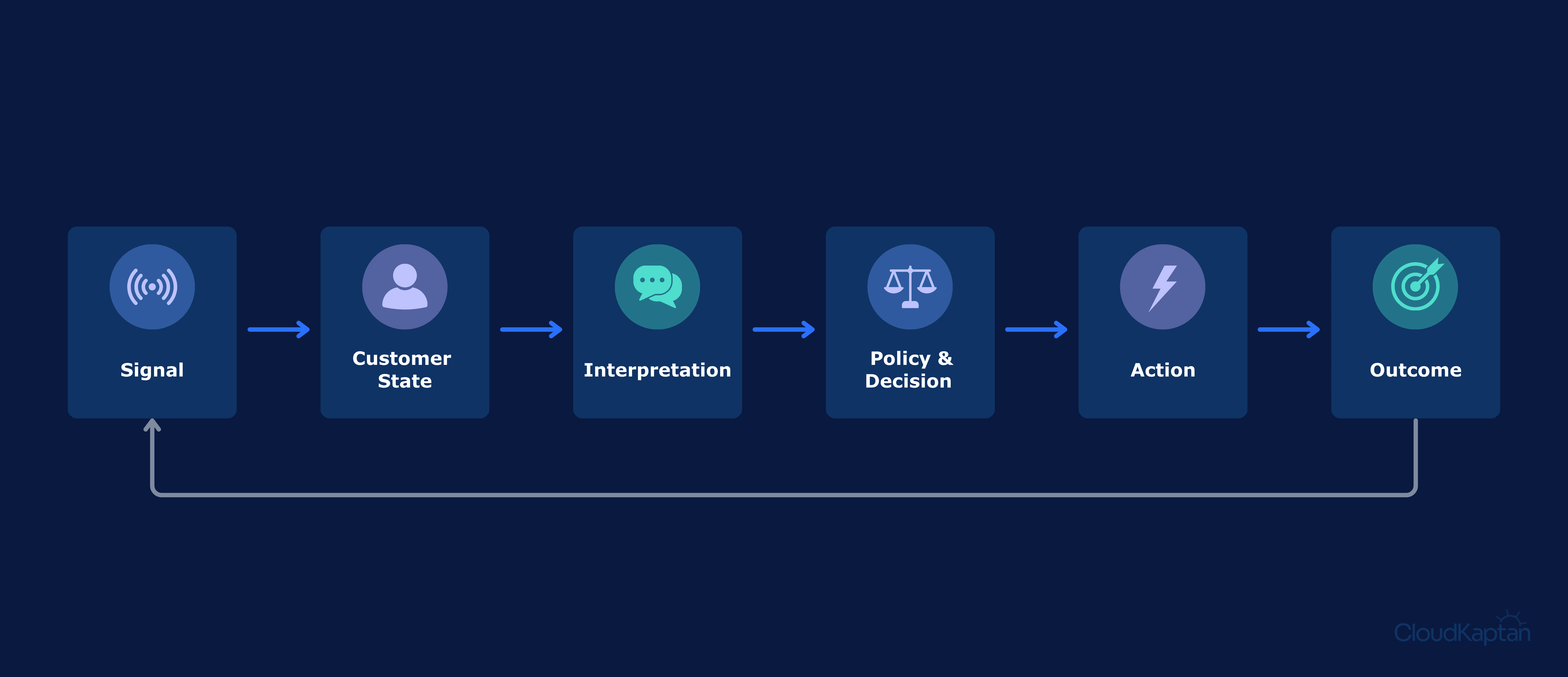
The result becomes part of the context available for the next decision. Customer intelligence is therefore no longer a linear flow from data to activation. It becomes a continuous loop of signal, interpretation, decision, action and evaluation. This is what makes the system agentic: the intelligence is used not only to describe the customer but to support what the enterprise should do next. Databricks brands this continuous loop of signal, decision and action as "Infinity Campaigns" always-on engagement that adapts as customer context changes, rather than a series of one-off launches.
From Traditional CDP to Agentic Customer Data Foundation
In an AI-led environment, customer data cannot remain a static profile that is refreshed, segmented and activated in periodic campaign cycles. It has to become a living foundation where identity, behaviour, context, governance and activation work together.
Core Components of an Agentic Customer Data Foundation
An agentic customer data foundation needs more than a unified customer profile. It needs technical layers that help AI understand, reason and act. CustomerLake today ships Customer 360, identity resolution, Profile and Campaign Agents, audience building, activation and Unity Catalog governance - a strong foundation to build from. The additional layers described here outline the enterprise-grade architecture organisations can grow toward as the agentic CDP category matures.
Customer 360 layer: connects profile, transaction, behavioural, service and engagement data into a fuller customer view.
Identity resolution layer: links customer records across systems so the same customer is not treated as multiple people.
Context and ontology layer: defines business terms, customer signals, metrics, relationships and rules so AI understands what the data means.
Agent layer: enables domain-specific agents for use cases such as churn analysis, next-best action, campaign planning, service prioritisation and account briefing.
Activation layer: connects intelligence back into CRM, marketing, service, sales and collaboration tools.
Governance layer: manages access, permissions, auditability and policy so AI outputs remain secure and explainable.
Agent operations layer: monitors agent behaviour, reasoning traces, memory, cost, tool usage and output quality so customer-facing agents can be improved and governed in production.
Databricks describes CustomerLake as an Agentic CDP embedded in the Lakehouse, bringing these capabilities directly into the environment where customer data and AI already sit.
CustomerLake replaces the traditional CDP's data-copying model with customer intelligence embedded directly in the Databricks Lakehouse which is democratized for marketers, autonomous through governed agents, with no data movement required.
How Models, Decision Engines and Agents Work Together
An agentic customer data foundation does not replace predictive analytics or business rules with a large language model. It coordinates them.
Predictive models estimate what may happen, such as the likelihood of churn, conversion or service escalation. Uplift and causal models estimate whether an intervention is likely to change that outcome. Decision engines determine whether an action is permitted, commercially appropriate and compliant. The AI agent brings these capabilities together by retrieving context, selecting approved tools and coordinating the next step across business systems. For environments using multiple agent harnesses, Databricks Omnigent adds a layer for composing and governing them.
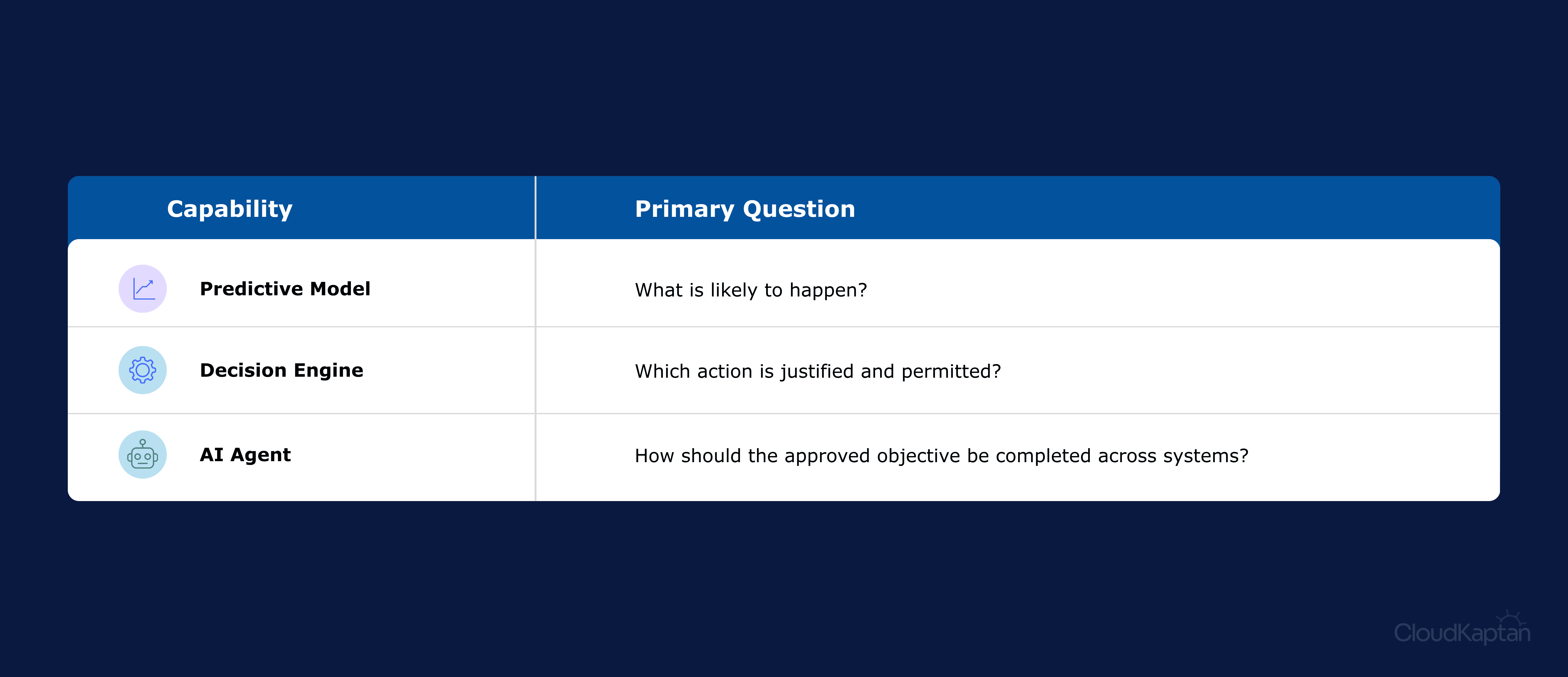
For example, an agent should not independently calculate whether a customer qualifies for a retention offer. It should call an approved eligibility service, retrieve the permitted actions and then explain, prepare or execute the result within its authority. The strongest architectures use agents for interpretation, investigation and orchestration while keeping stable calculations, eligibility checks and material business rules inside governed services.
The Technical Difference: Proximity and Control
The difference between a conventional CDP and an agentic customer data foundation is architectural in two important ways.
Proximity: Instead of moving customer data into another isolated system for campaign use, the foundation keeps intelligence closer to the data, models, semantics, governance and business logic that shape decisions.
Control: Beyond unification and activation, it must govern how agents use tools, which models they call, what information they can access, how much they may spend, what actions they may take and when human approval is required.
What an Agent Is Actually Allowed to Do
Control cannot depend only on an agent’s prompt. In production, the agent should propose an action while a separate policy and execution layer determines whether that action may proceed.
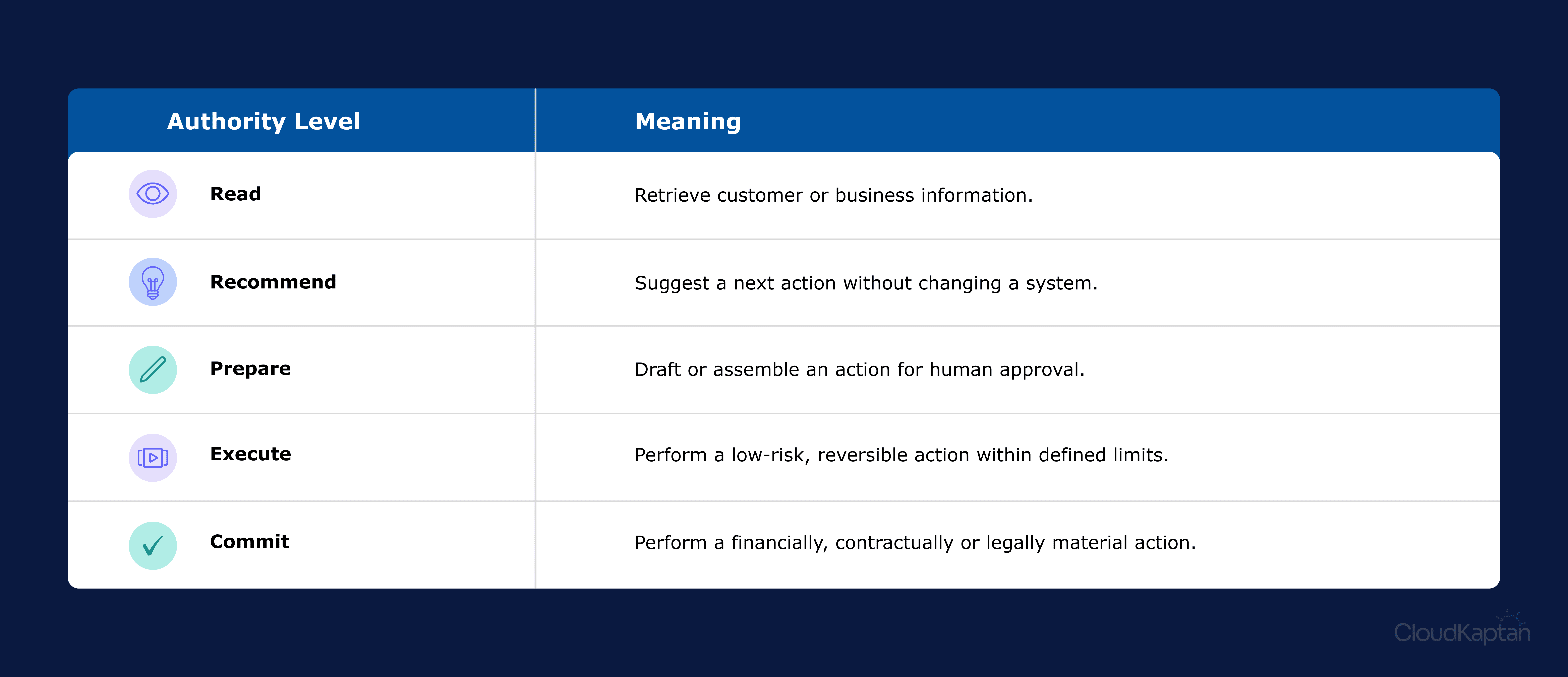
Each level requires different permissions, confidence thresholds and approval policies. An agent may be allowed to schedule a callback automatically, for example, while requiring human approval before issuing a financial credit or changing contractual information.
This creates three distinct layers: the agent interprets the objective and proposes the action; the control layer validates authority, consent, policy, risk and limits; and the execution layer performs the approved action through the relevant enterprise API. The separation is essential because observability can show that an incorrect action occurred, but runtime controls, supported by platforms such as Databricks Unity AI Gateway, can help prevent it from happening.
What This Means for Enterprise AI-Led Engagement
The next phase of enterprise engagement will not be defined by how many AI agents a business deploys. It will be defined by how well those agents understand the customer, the context and the action they are expected to support.
When customer data is fragmented, AI-led engagement can become fast but semantically weak . When customer data is connected, governed and enriched with meaning, AI can support engagement that is more relevant, explainable and consistent.
This changes the role of customer intelligence. It is no longer only a marketing asset or a reporting layer. It becomes part of the operating foundation for sales, service, product, risk and customer experience teams.
The future of customer intelligence is not a CDP that only stores and activates data. It is an agent-ready decision foundation where customer data, context, governance and activation come together to help AI understand customers and support better business decisions.
