Artificial Intelligence
Quality Engineering
AI Without Validation Is a Risk: Rethinking QE for the AI Era
Article

Saikat Das
7
min read

AI is being embedded into enterprise systems at an unprecedented pace.
Recommendation engines, customer service bots, document summarizers, clinical decision tools, financial advisors, and code generators are already in production. Yet most organizations running them cannot confidently answer one critical question:
“How evidently do we know the AI is actually behaving correctly?”
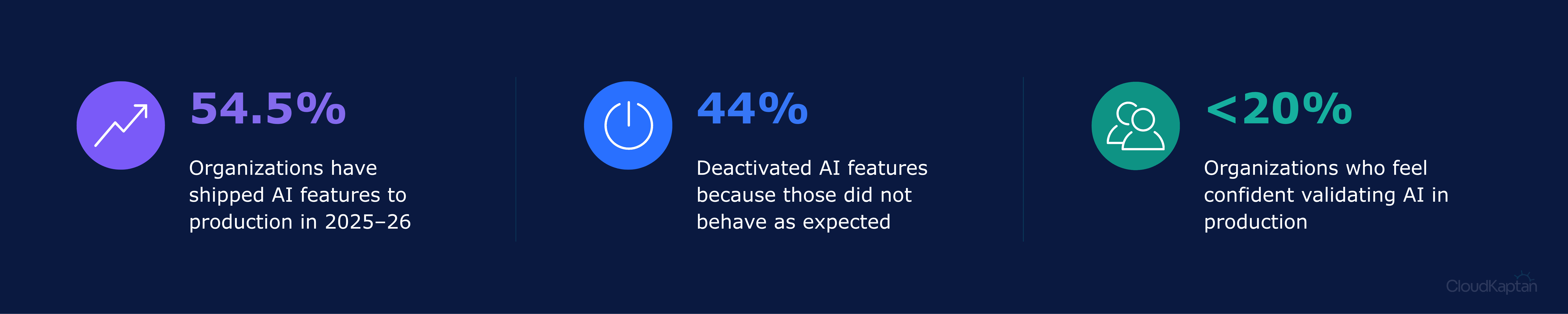
AI adoption is no longer experimental, but confidence in AI validation is still catching up. 54.5% of organisations have already shipped AI features to production in 2025–26, yet 44% have deactivated AI features because they did not behave as expected. More importantly, fewer than 20% of organizations feel confident validating AI in production.
Despite this gap, many organisations still rely on sprint-level manual reviews, run a few test prompts before go-live, and proceed to ship.
This is not a technology problem. It is a quality engineering gap, and one of the most under-addressed challenges in enterprise software today.
Why Deterministic QA Needs to Evolve for AI
To understand the quality challenge, we need to look at what makes AI systems fundamentally different from the software QE teams have traditionally tested.
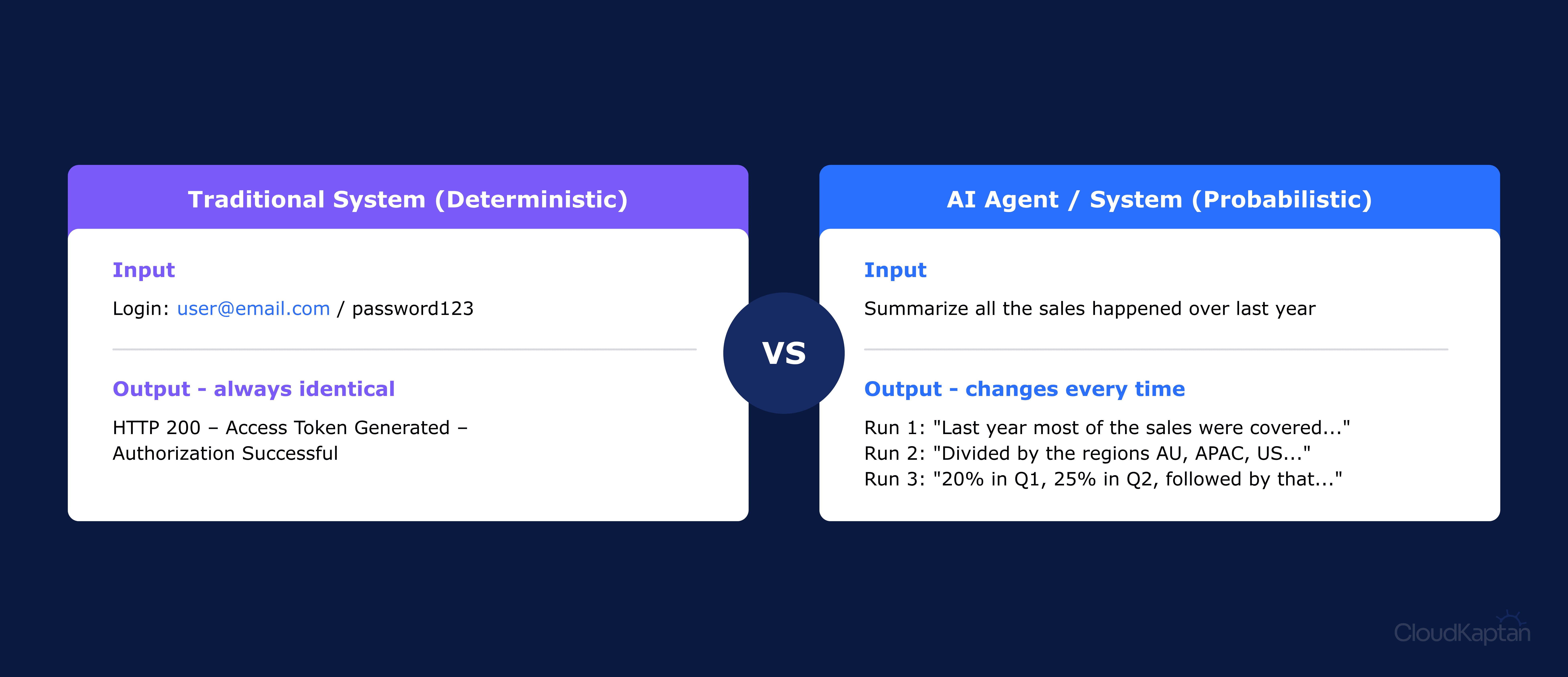
Traditional systems are deterministic. AI systems are probabilistic. This single difference breaks existing test frameworks.
Where Traditional QE Works Well
In a traditional system, the same input always produces the same output. A login form, a payment gateway, or a data pipeline is deterministic. We write a test case, define an expected output, and assert equality to determine whether it passes or fails.
This is what test automation, regression suites, and CI/CD quality gates were designed around. It works because the system does not surprise teams with unexpected behaviour.
The Probabilistic World QE Was Not Built For
AI systems built on large language models are inherently non-deterministic. The same prompt, executed multiple times, can produce different outputs due to probabilistic generation. They work on context-driven retrieval from vector embeddings rather than fixed rule-based logic. Context changes the response. Phrasing changes the response. The time of day, conversation history, and temperature setting can all influence what comes back.
There is no fixed expected output to assert against. That breaks:
Test cases: We cannot write a static expected result.
Automation scripts: Exact-match assertions intermittently fail or pass.
Validation logic: Validation becomes a spectrum check, not a binary outcome.
Regression suites: Functional drift cannot always be detected with traditional scripts.
The Critical Shift
We cannot test for exact outputs. We must test for meaning, quality, accuracy, and safety using evaluation models and scoring thresholds instead of pass/fail assertions. This is not simply an extension of what QE teams do today. It is a different discipline.
The Operational Void in AI Infrastructure
Here is the operational reality for many enterprises shipping AI in 2026.
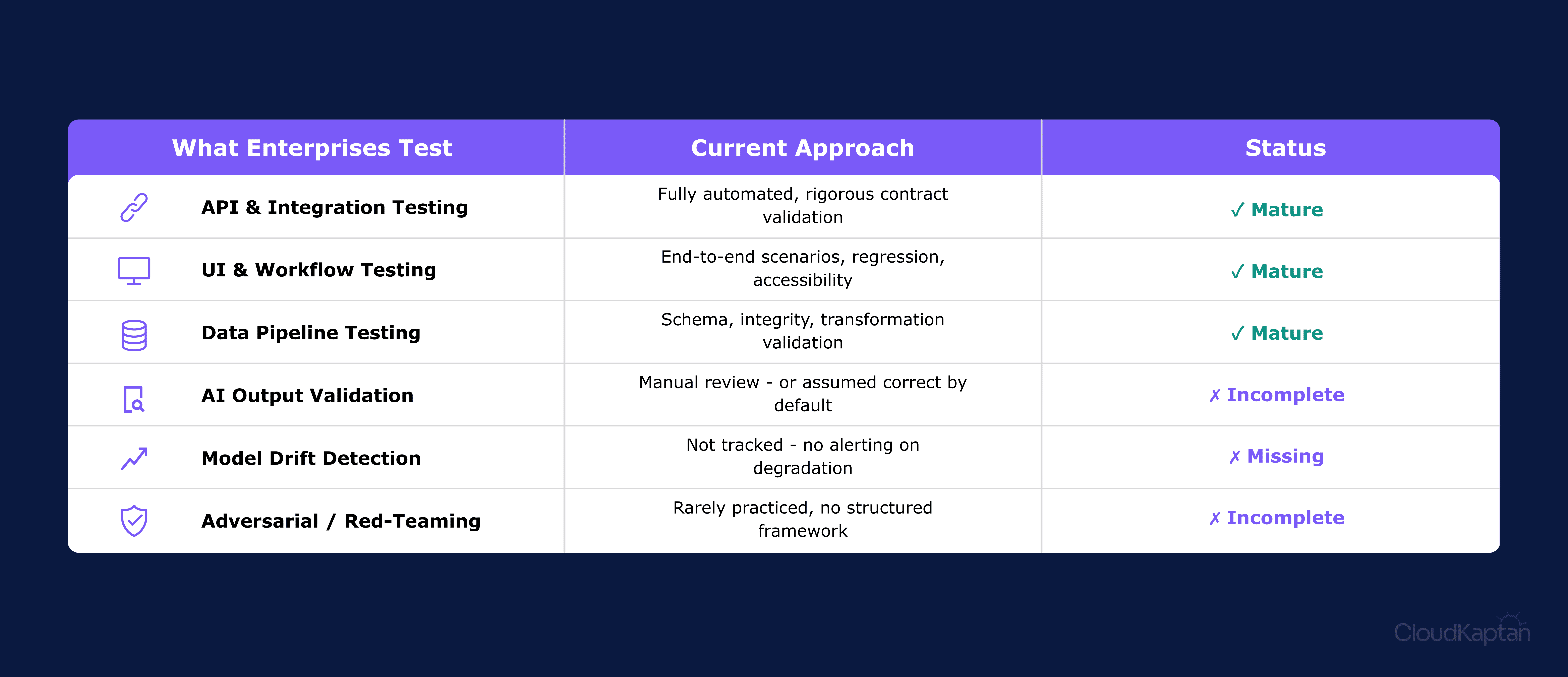
The gap is not about intent or capability. Most QE teams are highly capable. The problem is structural: the tools, frameworks, and practices they use were built for deterministic systems. They were not designed for probabilistic outputs.
As a result, enterprises can end up with a false sense of confidence. The APIs are tested. The UI flows work. The data pipelines are validated. But the AI making decisions, summarizing documents, responding to customers, and advising clinicians may still be running with limited validation.
Validating the APIs around an AI model is not the same as validating the model. It is like checking whether a car’s dashboard lights turn on without verifying whether the right warning appears at the right moment.
Mapping the Strands of Model Failure
When AI goes wrong in production, it does not always throw an error code. It does not always trigger a test failure. It produces an output confidently, fluently, and plausibly. That output may still be wrong, biased, inconsistent, or unsafe.
These are not conventional bugs. They are behavioural risks, and they require a different approach to detection.
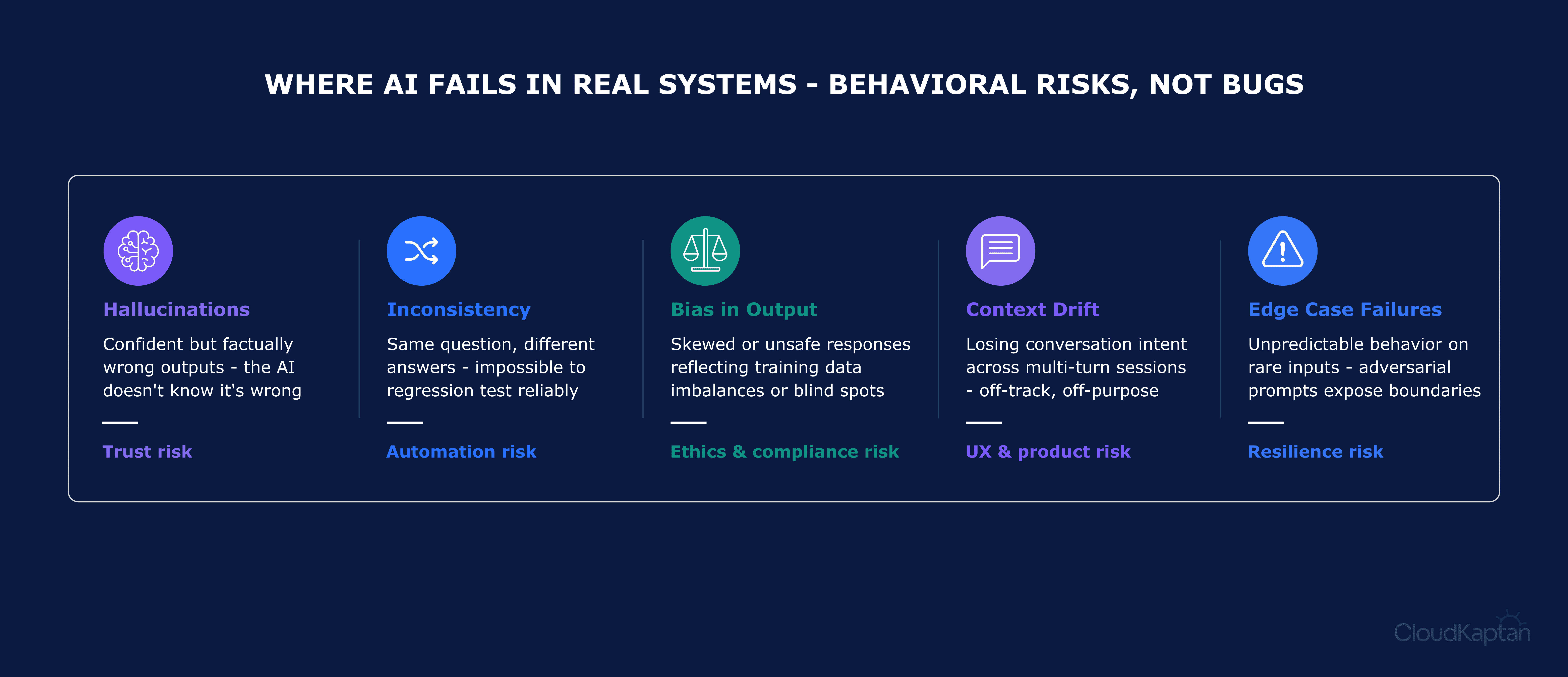
Five categories of AI output failure – each invisible to traditional QA frameworks:
Hallucinations: The AI produces information that is factually incorrect – but presents it with the same confidence and fluency as correct information. E.g., A legal AI that cites a case that was never recorded. A financial AI that reports figures that were never published. The model doesn't know it's wrong, which means users often don't either. Drifts in data or concept are also some of the effects.
Inconsistency: Ask the same question twice and get meaningfully different answers. For a customer-facing chatbot, this erodes trust. E.g., For a clinical decision tool, it is a governance problem. For any system where repeatability matters, it is a fundamental quality failure.
Bias in output: Outputs that are skewed by demographic assumptions, that apply different standards to similar queries, or that systematically underserve certain user groups. Bias is hard to detect without specifically testing for it and almost no organisations do.
Context drift: Describes what happens in long, multi-turn conversations when the model gradually loses track of the original intent. E.g., A customer support conversation that was about a billing dispute slowly drifts to irrelevant suggestions. The model is functioning but not for the task at hand.
Edge Case Failures: These case failures emerge under adversarial inputs, unusual phrasing, or rare scenarios that the model was never optimized for. These are the failure modes that red-teaming is meant to surface, but red-teaming is still often practiced by small teams only before production
The Blueprint for Continuous Behavioural Evaluation
The answer is not to abandon the principles of QE, but to evolve them. The core purpose remains the same: building confidence that a system will behave correctly in the real world. What changes is the testing mindset required for AI systems.
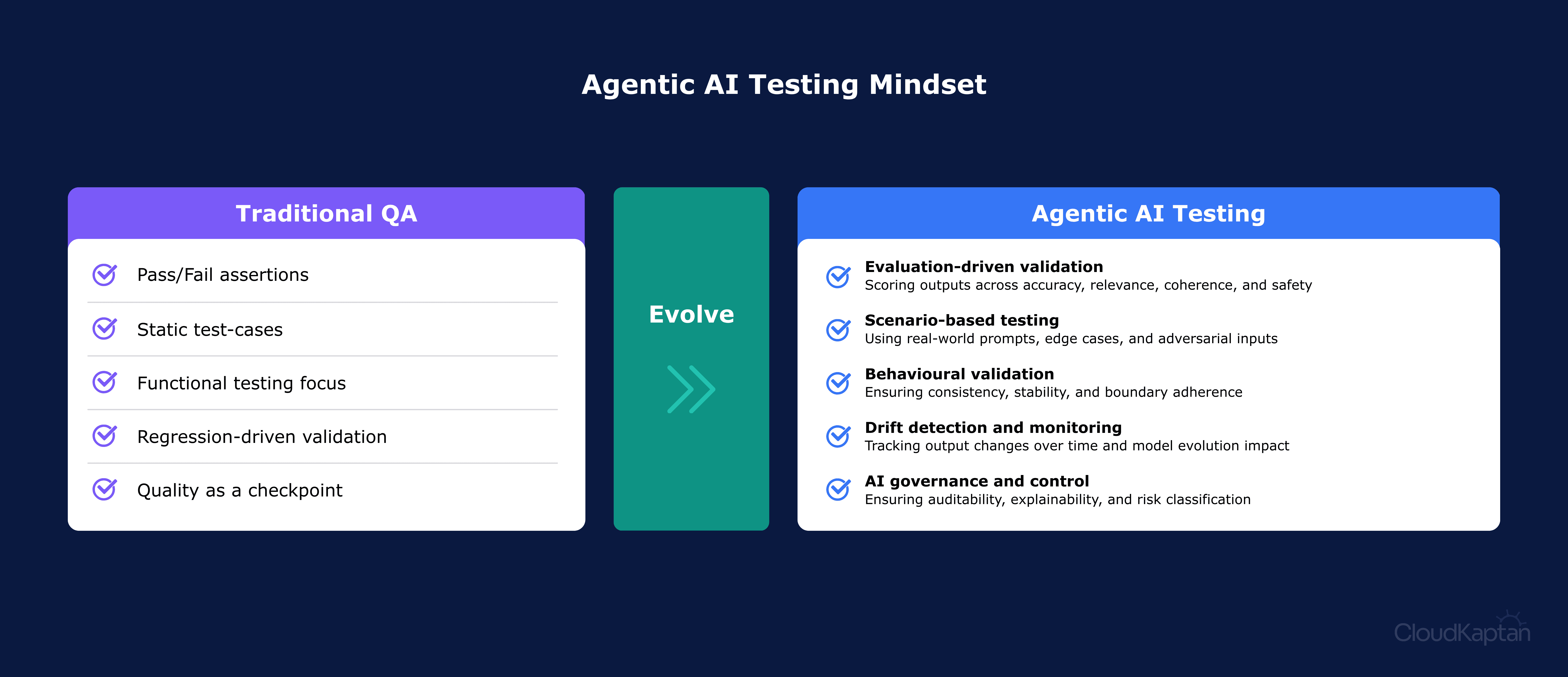
The Five evolutionary shifts QE teams must make to validate AI systems effectively:
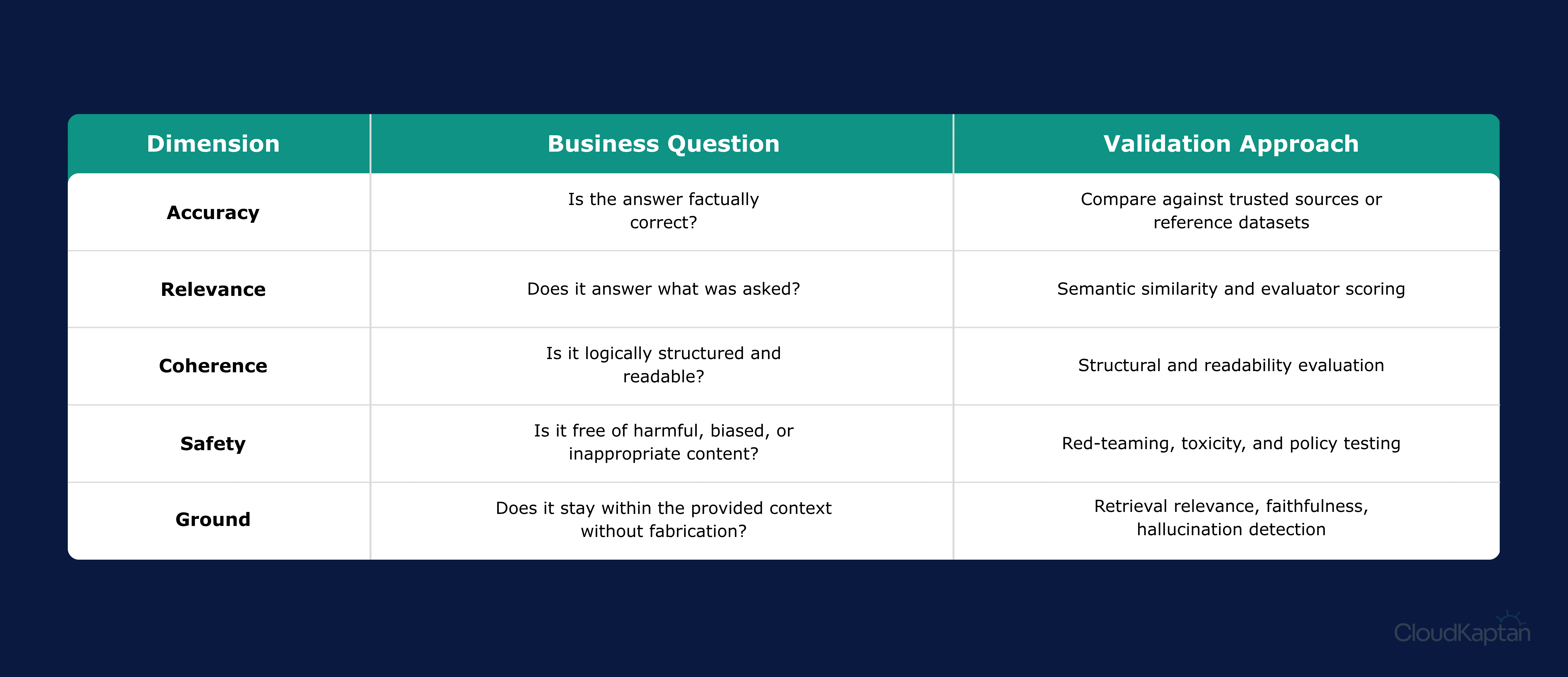
From Validation to Evaluation Models
Instead of asserting an exact output, QE teams score outputs across five dimensions: accuracy, relevance, coherence, safety, and context adherence. Each dimension requires its own validation technique.
From Test Cases to Scenario Libraries
Static test cases cannot capture the variability of AI behaviour. What works instead is a curated library of real-world prompts, edge cases, and adversarial inputs that is maintained, versioned, and expanded as requirements change. The scenario library becomes an asset, not a file written once.
From Functional Testing to Behavioural Testing
Functional testing asks: does it work? Behavioural testing asks: does it consistently behave the way it is supposed to across varied inputs, over time, and under pressure? Consistency, stability, and response boundaries all need to be explicitly validated.
From Regression Testing to Drift Detection
Model providers update their models. Prompt templates get tweaked. New data enters the system. Any of these can change the quality of AI outputs without triggering a single test failure in a conventional regression suite. Drift detection monitors output quality continuously and alerts teams when data or concept behaviour begins to degrade before end users report it.
From QA to AI Governance
The final evolution is the most significant. AI systems are decision-makers. They need to be auditable, which means teams must be able to explain why an output was produced. Not all AI failures carry equal consequences, so AI systems also need explainability frameworks that support reasoning and derivation.
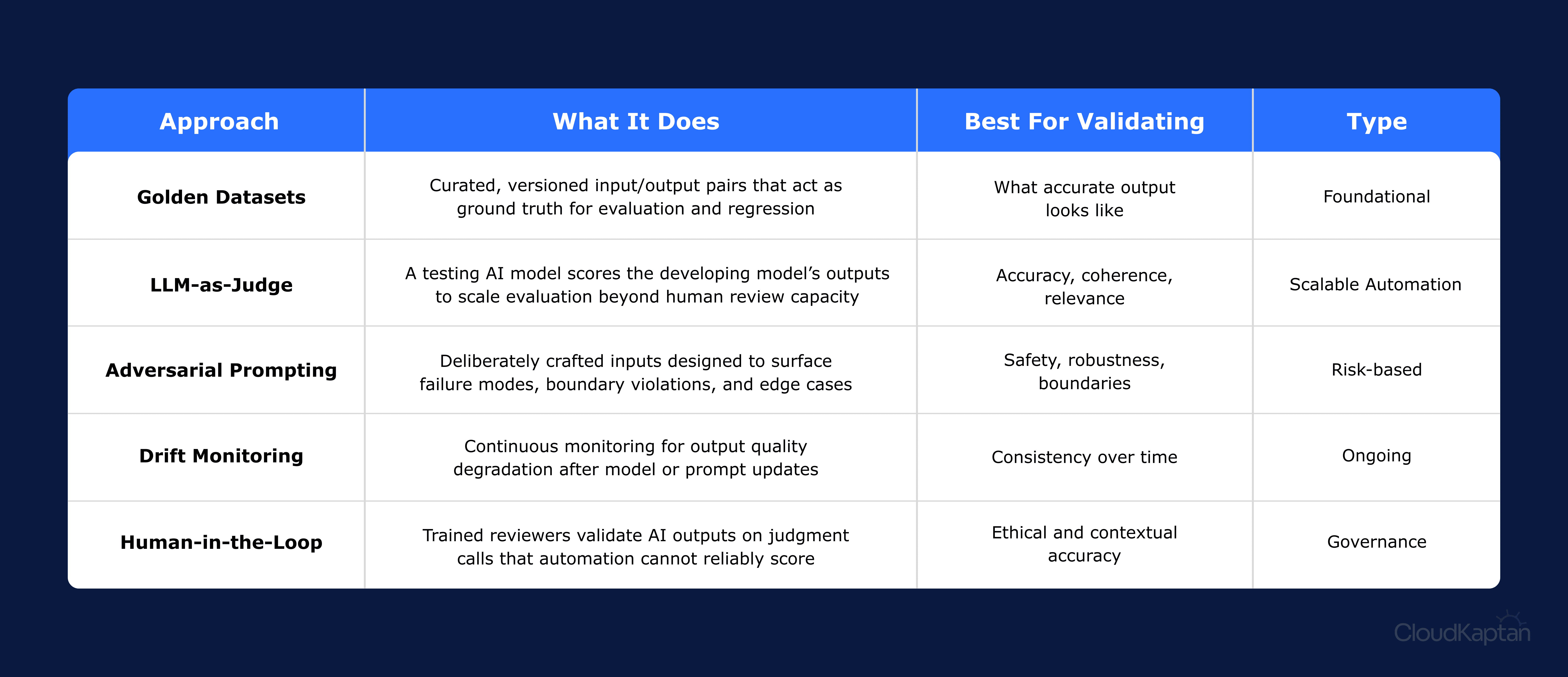
The Architecture of Modern Enterprise Framework
A practical AI output validation practice is built on a small set of complementary approaches. None of them existed in QE toolkits five years ago.
The Human-in-the-Loop Reality
Automation scales evaluation, but it does not replace human judgment on the hardest calls. By 2026, a good number of enterprises had implemented explicit human review processes for AI outputs. However, this reduces some traditional test automation benefits.
The goal is not full automation of agentic AI testing. It is right-sized automation, where automation handles test volume, golden datasets, and response pattern detection, while humans handle judgment and governance.
Focus Shift: From System Validation to Behavioural Validation
“AI systems don't fail like software. They fail like decision-makers.”
This is why Quality Engineering must evolve from validating systems to validating behaviour and trust. The bar is not “does it run without crashing?” The bar is “can we trust what it produces at scale, over time, under adversarial conditions, and across diverse users?”
Fewer than 20% of enterprises feel confident validating AI behaviour in production today. Most AI initiatives fail not because of the model, but because enterprises lack the validation, monitoring, and governance required to operate them at scale. These are not predictions about the future. They are descriptions of what is already happening.
The Time to Build AI Validation Is Before Scale
Focus is to expose the gap before scale. But, building golden datasets, adversarial test libraries, drift monitoring pipelines, and AI governance frameworks takes time. These capabilities depend on the nature of the AI systems whether conversational (talks with human and responds) or headless (works internally when a functionality triggers an automation), there cannot be a reusable framework like we use in traditional QA.
What helps is a structured testing checklist: when to check drift monitoring, which cases require LLM-as-judge automation, whether adversarial prompts have been covered, and where human review is required.
Building the Foundation to Reliable AI
AI is the next inflection point for QE where systems are more complex, outputs non-deterministic, and consequences are measured in trust, not just functionality.
For enterprises, success with AI depends not just on deployment but on validating behaviour across real-world scenarios, changing data, adversarial inputs, and critical decisions. This makes Quality Engineering a strategic capability, combining evaluation frameworks, monitoring, governance, and human oversight to build confidence before AI systems scale.
At CloudKaptan, we help enterprises strengthen this foundation by aligning your practices with the way AI systems are designed, tested, monitored, and governed. From AI output validation and automation strategy to risk-based testing and implementation readiness, the goal is simple: help organizations build AI systems they can trust in production.
