Salesforce
Artificial Intelligence
Cloud
Building AI Ready API Governance with MuleSoft Omni Gateway
Article

Kiranmoy Pradhan
7
min read

As artificial intelligence moves from experimentation to production, the role of API governance is being reconsidered. What was once designed for predictable application traffic must now support dynamic, agent-driven interactions across complex enterprise systems.
As organisations moved from monolithic applications to micro-services, SaaS platforms, and hybrid cloud environments, APIs became the common interface that allowed systems to communicate with each other. To manage this growing API landscape, enterprises adopted API gateways that provided security, traffic management, monitoring, and governance.
For a long time, this model worked well. Applications called APIs, gateways enforced policies and organisations maintained control.
But we're now entering a new phase of enterprise computing and the assumptions behind traditional API consumption and governance are beginning to change.
How AI Agents Are Changing API Consumption
The evolution of API governance is closely tied to the evolution of API consumption. For years, APIs were consumed primarily by known applications operating through defined workflows. Governance, in turn, was built around applications, developers, access policies, and predictable traffic patterns.
That environment is now changing. Enterprise AI is no longer limited to innovation labs, pilot programs, or proof-of-concept initiatives. Organisations are deploying:
Internal copilots
Customer service assistants
Knowledge agents
Document processing solutions
Increasingly autonomous workflows
What began as experimentation is now becoming part of everyday business operations.
The important difference is that these systems do not behave like traditional applications. A typical application follows a predefined workflow. Developers determine which APIs are called, when they are called, and under what conditions those calls are made.
AI systems operate differently. An AI assistant may decide which tool to use based on the context of a conversation. An autonomous agent may discover available services and dynamically select which APIs to invoke. A workflow agent may interact with multiple systems while executing a business process without requiring direct human intervention at every step.
Consider a customer support agent powered by AI. A customer asks about an order status.
The AI assistant may:
Retrieve customer information from Salesforce
Query order details from SAP
Check shipping status from a logistics platform
Generate a personalised response
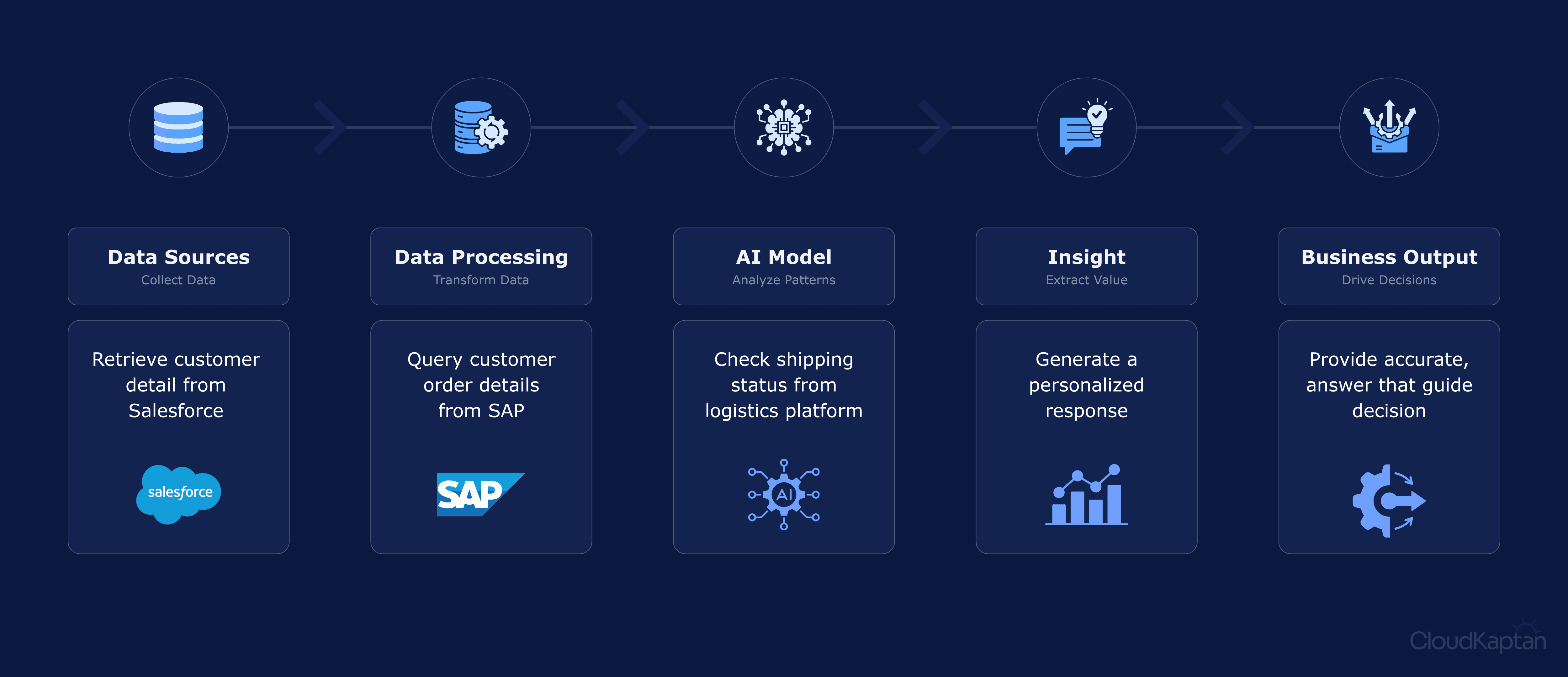
Behind the scenes, multiple APIs are being invoked automatically.
Now multiply that pattern across hundreds or thousands of AI-powered interactions every day.
The number of API consumers is growing, but more importantly, the nature of those consumers is changing.
We are moving from application-to-application interactions to agent-to-system and eventually agent-to-agent interactions.
This shift changes the role of governance. It is no longer enough to govern APIs only as technical endpoints or application traffic. Enterprises must also govern which agents can access which services, what data they can retrieve, how those interactions are monitored, and whether every action can be audited.
In this environment, API governance becomes a mandatory foundation for responsible AI adoption. Without it, organisations may scale AI-driven interactions faster than they can secure, monitor, or control them. With the right governance model, they can support AI innovation while maintaining the visibility, security, and operational discipline required in modern enterprise architecture.
MCP Is Accelerating the Shift
One of the most interesting developments in the AI ecosystem is the adoption of the Model Context Protocol (MCP).
MCP provides a standardised way for AI models to discover and interact with external tools and services. From an enterprise perspective, this is significant.
Historically, integrations were built explicitly by development teams. Every connection between systems was designed, coded, and governed.
MCP introduces a more dynamic model. Instead of hardcoding every interaction, organisations can expose enterprise capabilities that AI systems can discover and use when needed.
This creates tremendous opportunities for productivity and innovation. It also creates new governance challenges:
If an AI assistant can dynamically discover tools, how do you control which services it can access?
How do you ensure sensitive data isn't exposed?
How do you maintain consistent security policies across hundreds of APIs and AI interactions?
These questions are becoming increasingly important as enterprises expand their AI landscape.
The Governance Rules We Relied On No Longer Fit
Most governance frameworks were designed around predictable application behaviour. Applications generally follow known workflows. Their traffic patterns are relatively consistent. Their permissions are well understood.
AI introduces a different operating model. An agent may invoke APIs based on reasoning rather than predefined logic. Multiple agents may collaborate to complete a task. The same prompt may generate different execution paths depending on context.
As a result, organisations face several new challenges:
Visibility
Many enterprises already struggle to maintain visibility across their API landscape. Adding AI agents introduces another layer of complexity.
Leaders need answers to questions such as:
Which agent initiated a request?
Which APIs were called?
What data was accessed?
Which model participated in the decision-making process?
Without visibility, governance becomes difficult.
Security
AI systems often require access to enterprise data. Customer information, financial records, contracts, product catalogs, and operational data all become potential inputs to AI-driven workflows.
The challenge isn't simply authenticating requests.
Organisations must ensure that AI systems access only the information they are authorised to use and that sensitive data remains protected throughout the interaction lifecycle.
Consistency
Most large enterprises don't operate a single gateway platform.
Over time, acquisitions, cloud strategies, and independent technology decisions have created diverse API ecosystems like Kong, Apigee, AWS API Gateway, Azure API Management, and MuleSoft gateways operating within the same organisation.
Each platform may implement governance differently. As AI adoption increases, inconsistent governance becomes a much larger risk.
The Multi-Gateway Reality
In many organisations, API governance is fragmented:
One business unit manages APIs through Apigee.
Another uses AWS API Gateway.
A third relies on Kong.
Meanwhile, integration teams may be using MuleSoft to expose enterprise services.
Each platform solves a local problem. The challenge emerges when organisations attempt to establish enterprise-wide governance:
Security teams want consistent policies.
Compliance teams want centralised reporting.
Architecture teams want visibility across the entire landscape.
Without a unified approach, governance becomes increasingly difficult to scale. This problem existed before AI. AI simply makes it impossible to ignore.
Why MuleSoft Omni Gateway Is Arriving at the Right Time
At first glance, MuleSoft Omni Gateway may appear to be another addition to the gateway technology.
That perspective is too narrow. The more important shift is that Omni Gateway treats governance as an enterprise capability rather than a gateway-specific capability.
Key Capabilities of MuleSoft Omni Gateway
It retains its core function as an ultrafast, lightweight API gateway but has been expanded to serve as a unified control plane that governs APIs, Large Language Model (LLM) calls, AI agents, and multi-vendor environments.
Beyond the rename, three capabilities stand out:
Multi-Vendor Federation: Most large enterprises use multiple gateway platforms such as Kong, Apigee, AWS API Gateway, Azure API Management, and MuleSoft. Omni Gateway provides a single governance layer across these environments, allowing teams to manage policies, security and compliance centrally from Anypoint API Manager.
AI and Agent Governance: Traffic from MCP servers, LLMs, and agent‑to‑agent interactions can now be governed just like REST APIs. Policies such as MCP Support, Attribute‑Based Access Control, PII detection and Prompt decoration extend your existing API governance to agent traffic.
MCP Bridge: Omni Gateway can expose existing REST APIs as MCP-compatible tools without requiring application changes. This allows AI agents and LLMs to securely discover and use enterprise services while preserving existing authentication, authorisation, auditing, and monitoring controls.
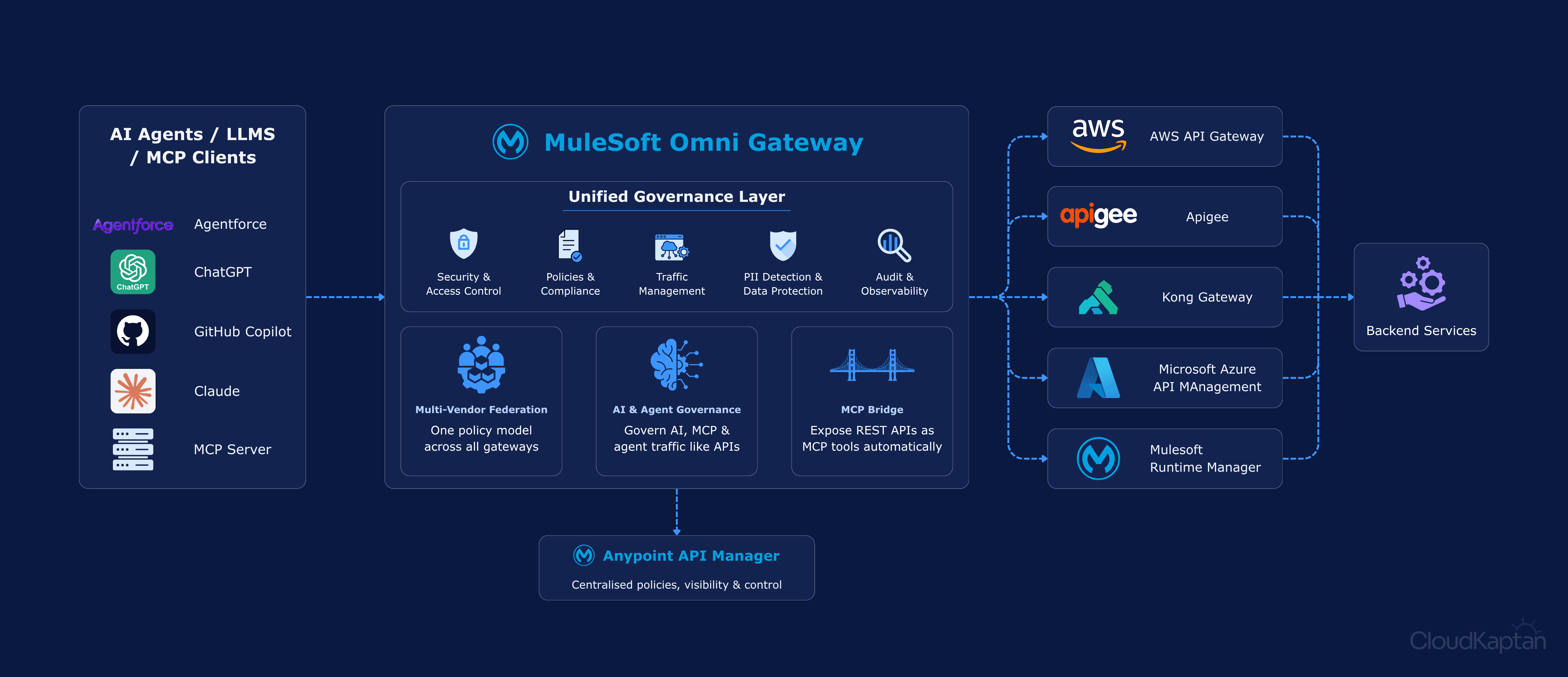
Instead of focusing on a single gateway platform, it provides a way to establish governance across a distributed API ecosystem.
That distinction matters. The future enterprise will not operate a single gateway. It will operate multiple gateways, multiple clouds, multiple AI models, and multiple agent frameworks. Governance needs to span all of them.
Omni Gateway moves in that direction by enabling centralised policy management, consistent security controls, and unified visibility across heterogeneous gateway environments.
Rather than replacing existing investments, it allows organisations to govern them more effectively.
Consider and enterprise assistant powered by a large language model.
An employee may ask the assistant to identify all open customer escalations associated with the organisation’s five most strategic accounts.
To answer this question, the assistant may need to:
Access Salesforce
Retrieve data from ServiceNow
Access internal knowledge repositories
Each interaction generates API calls. Without governance, these interactions can quickly become difficult to monitor and control.
With a centralised governance layer, organisations can apply consistent authentication, authorisation, auditing, and monitoring policies regardless of where the APIs are hosted.
The goal isn't to restrict innovation. The goal is to make innovation scalable and trustworthy.
Looking Ahead: The Agentic Enterprise
Many organisations are currently focused on copilots and AI assistants. The next stage will be autonomous agents.
Instead of assisting users, these systems will execute tasks on their behalf:
A sales agent may negotiate pricing.
A procurement agent may create purchase requests.
A service agent may coordinate actions across multiple business systems.
Eventually, agents will collaborate with other agents. This is where concepts such as Agent-to-Agent (A2A) communication become increasingly relevant.
In that environment, APIs remain critical. What changes is the entity consuming them.
The architecture of the future may look less like applications calling services and more like intelligent agents orchestrating business capabilities across the enterprise.
When that happens, governance becomes even more important.
Building The Governance Foundation Ahead
For years, API governance was primarily about managing traffic, enforcing security, and protecting services. Those responsibilities remain important.
What's changing is the environment in which governance operates.
AI agents, MCP-enabled tools, and autonomous systems are introducing new patterns of interaction that traditional governance models were never designed to address.
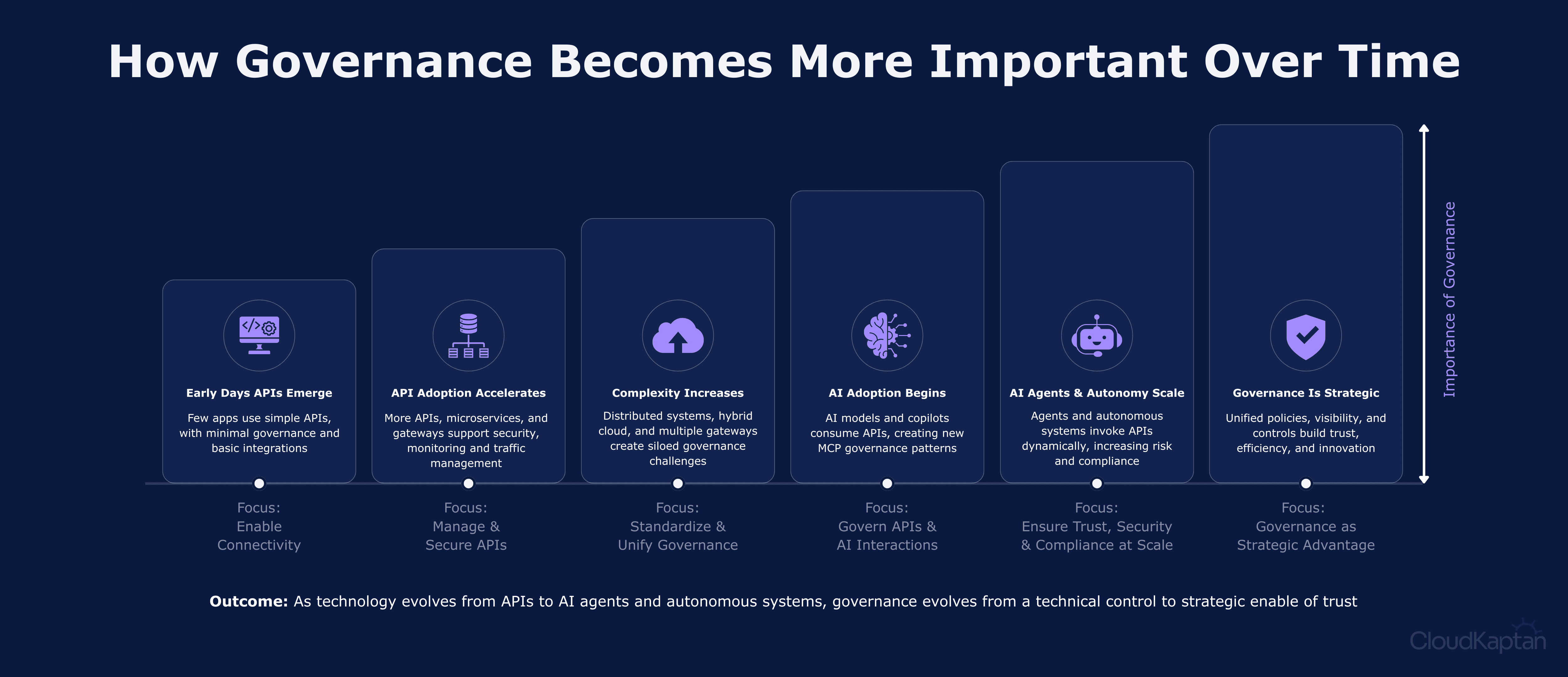
The organisations that succeed over the next decade won't simply be the ones that adopt AI the fastest.
They'll be the ones that can scale AI responsibly while maintaining security, visibility, and operational control.
From that perspective, MuleSoft Omni Gateway is more than a gateway strategy. It's an important step toward establishing the governance foundation required for the next generation of enterprise architecture.
