

For years, digital transformation was treated as a modernization exercise: move data to the cloud, replace an on-premises ERP, or give the customer portal a new interface. The goal was efficiency, and the benchmark was speed of delivery.
In 2026, digital transformation has become an operating model shift. It is no longer only about updating systems; it is about rebuilding how an enterprise creates value, serves customers, makes decisions, and responds to change. The technology is the enabler, but the change itself is structural.
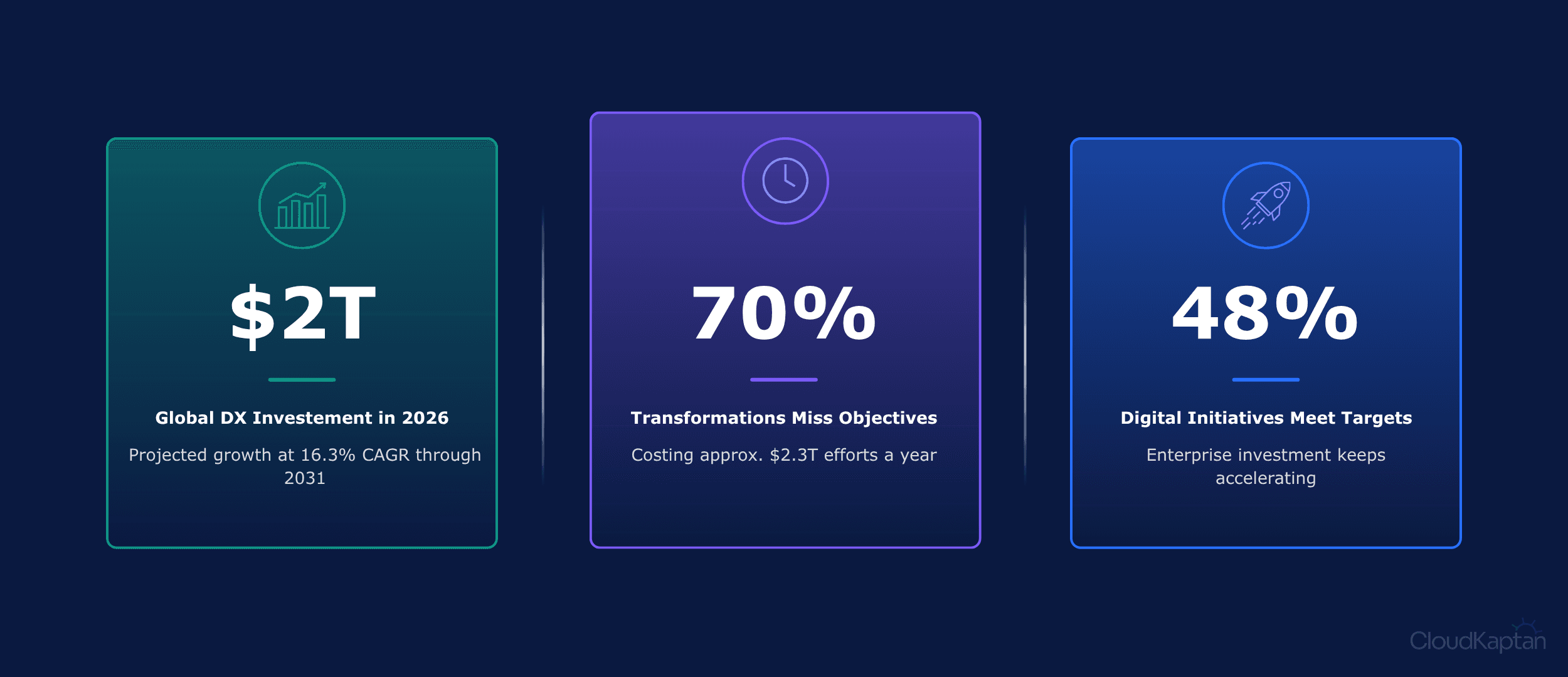
The global digital transformation market is projected to exceed $2 trillion in 2026. Yet 70% of digital transformations fail to meet their objectives, and only 48% of digital initiatives achieve their intended business outcomes. The competitive gap between those who adapted and those who did not is now structural.
This is where Quality Engineering enters, not as a final checkpoint, but as a discipline that supports transformation readiness from planning through production. It helps validate complex dependencies early and gives enterprises greater confidence that transformation outcomes will work beyond the implementation plan.
What Enterprises Are Transforming and What Businesses Expect
Digital transformation is not a single initiative. Inside any large enterprise, transformation is happening simultaneously across multiple systems, each with different risk profiles, failure consequences, and stakeholder expectations.
Systems Currently Being Transformed
Core Banking and Financial Platforms: Legacy mainframe systems are being re-architected into cloud-native, API-first platforms for real-time transactions, regulatory compliance, and fintech integration. Failures are immediately customer-visible, regulatory, and reputational.
Healthcare Systems: EHRs, patient engagement platforms, diagnostic tools, and clinical decision systems are converging into integrated care ecosystems. Failures can carry patient safety consequences and HIPAA obligations.
Manufacturing: Operational technology is converging with IT through IoT-connected floors, digital twins, and predictive maintenance. Integration between legacy OT and new digital platforms introduces significant interoperability complexity.
Retail and Commerce Platforms: Monolithic platforms are being decomposed into microservices with real-time inventory, personalisation engines, and omnichannel fulfilment. In this environment, the customer experience is closely tied to system reliability.
ERP and Enterprise Operations: SAP and database migrations touch finance, HR, procurement, and supply chain at the same time. Process integrity is non-negotiable because disruption in one function can quickly affect the wider business.
Government and Public Services: Decades-old civil service infrastructure is being re-engineered for citizen-facing digital access. Complexity, procurement cycles, and public accountability make this one of the most demanding transformation environments.
What Businesses Expect from Transformation and the QE Dependency
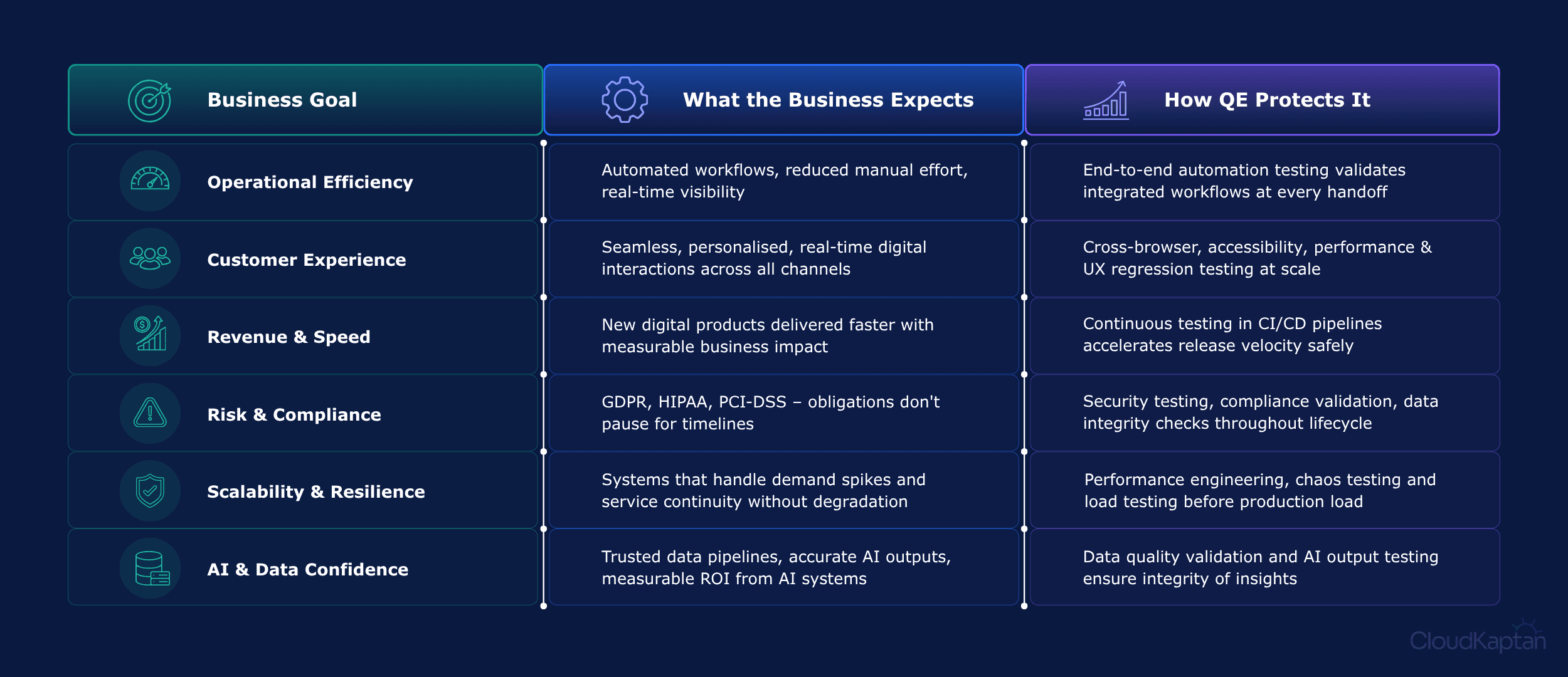
Every business goal in a transformation programme has a quality dependency. The table below maps what sponsors are trying to achieve against the QE capability that protects it.
Why Transformation Fails Without Quality Engineering
The failure patterns in digital transformation are well-documented and consistent across sectors. Over 60% of enterprise transformation programmes, particularly ERP and core system migrations, experience significant delays. The causes are not usually inadequate technology choices. More often, they are inadequate testing coverage at integration points and incomplete business process validation.
The architectural reality is that the failure point is almost never the new system in isolation. It is where the new system meets the legacy system it is replacing, or the ecosystem it is joining.
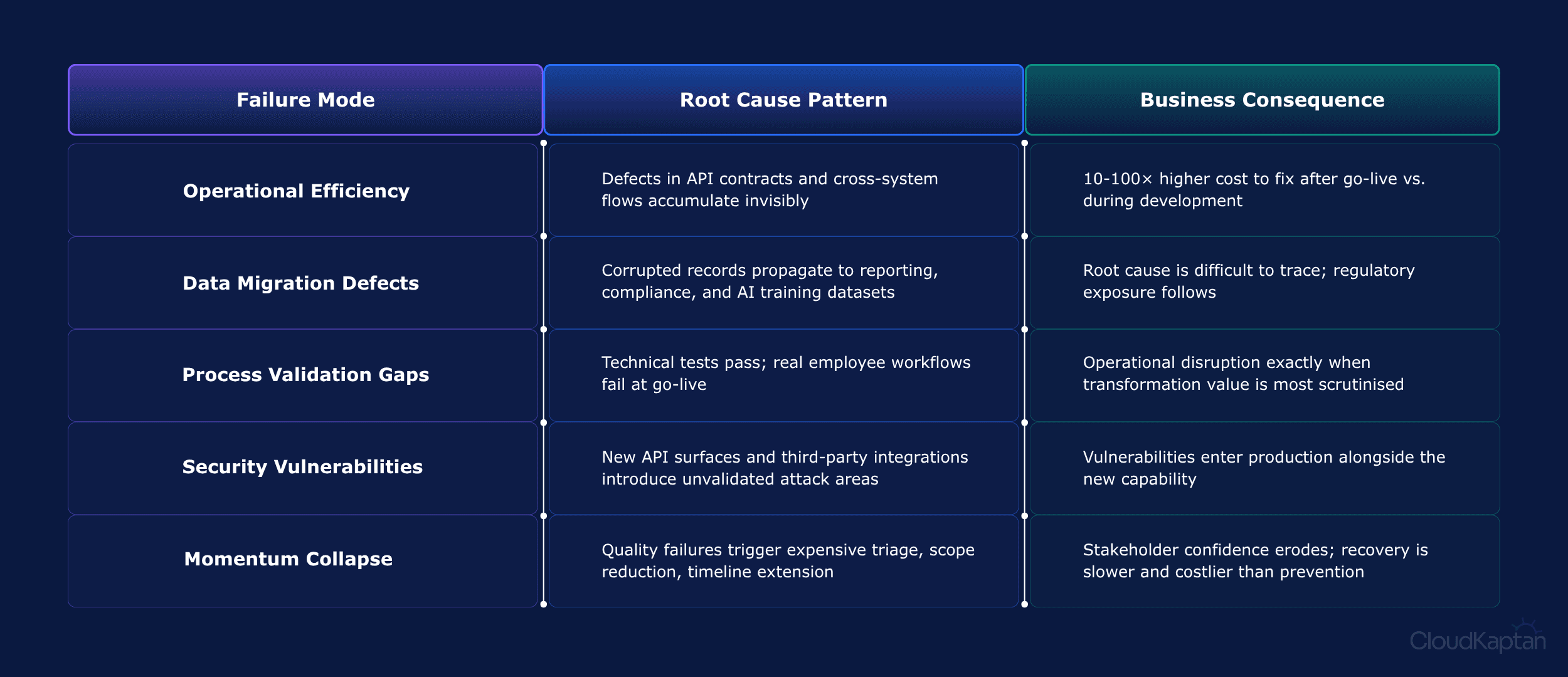
A missed API contract, an incomplete migration rule, a workflow that passes technical testing but fails in business use, or a performance assumption left untested can all become operational issues at go-live. By then, the problem is no longer only a defect. It becomes a delay, a compliance risk, a customer experience issue, or a loss of stakeholder confidence.
The Changing Role of Testing in Digital Programs
Traditional QA was designed for a different context. It operated at the end of a development cycle, against defined requirements, and produced a pass or fail verdict on a relatively stable system. Digital transformation programmes break every one of those assumptions.
Systems are complex, distributed, and continuously evolving. Multiple teams, vendors, and workstreams operate in parallel. Release cycles are measured in days, not quarters. The systems being tested are a combination of new platforms, legacy integrations, third-party APIs, cloud services, data pipelines, and AI components.
The shift to Quality Engineering reflects a different operating model:
From reactive to preventive: QE embeds quality thinking into requirements, architecture decisions, and API design before a line of code is written.
From stage-gate to continuous: quality gates become automated checks embedded throughout the CI/CD pipeline, not checkpoints before release.
From test execution to quality intelligence: QE teams generate defect trends, coverage gaps, and risk signals that inform delivery decisions.
From UI-focused to integration-first: the highest-value testing surface in enterprise transformations is often the integration layer, not only the presentation layer.
From compliance to confidence: effectiveness is measured through release confidence, business-flow coverage, production incident trends, and readiness signals, not only test pass rates or defect counts.
Modern QE Practices for Digital Transformation
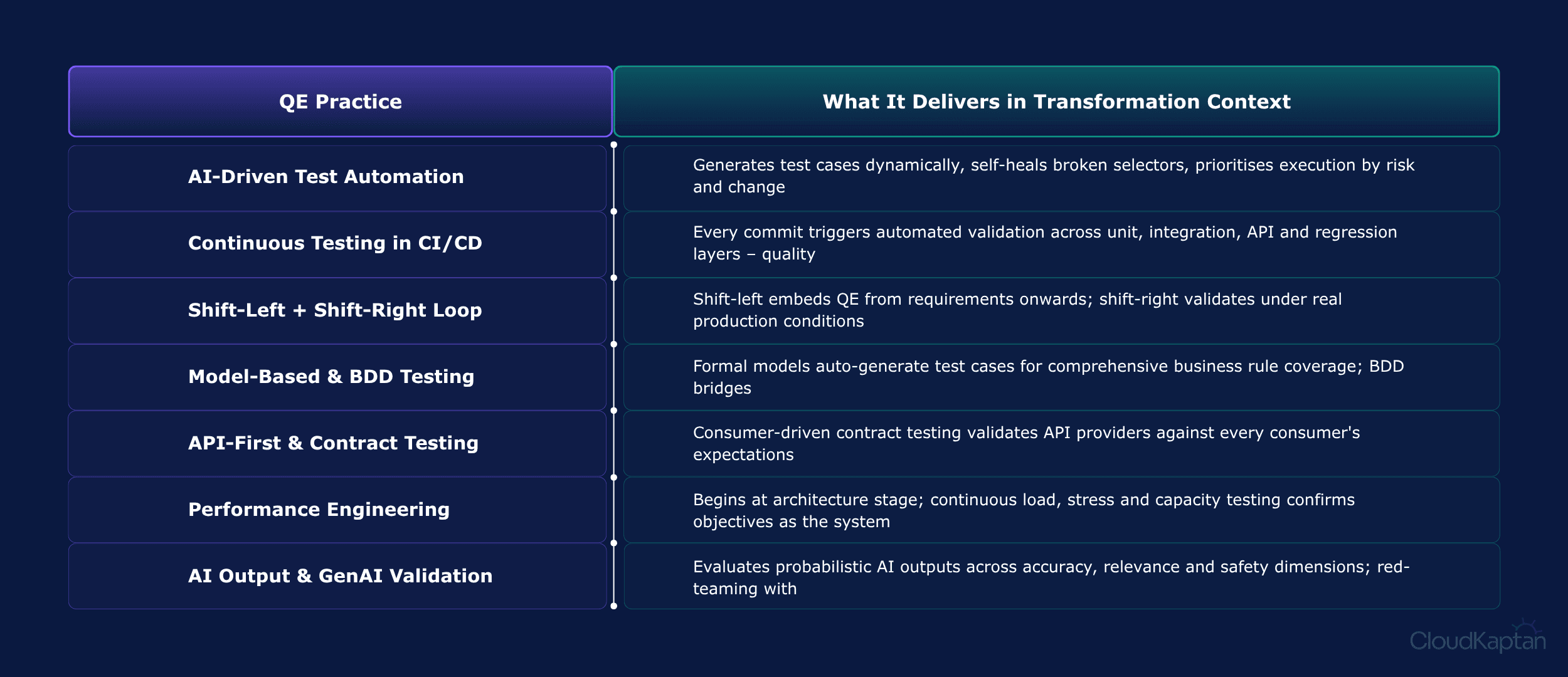
The QE practices characterising leading delivery organisations in 2026 are not emerging experiments. They are production disciplines applied at enterprise scale. What distinguishes leaders is systematic implementation across the delivery lifecycle.
The Unified Quality Practice
The most mature QE organisations no longer debate shift-left versus shift-right. They operate both as part of a unified continuous quality ecosystem, validating from the first requirement through to live production behaviour.
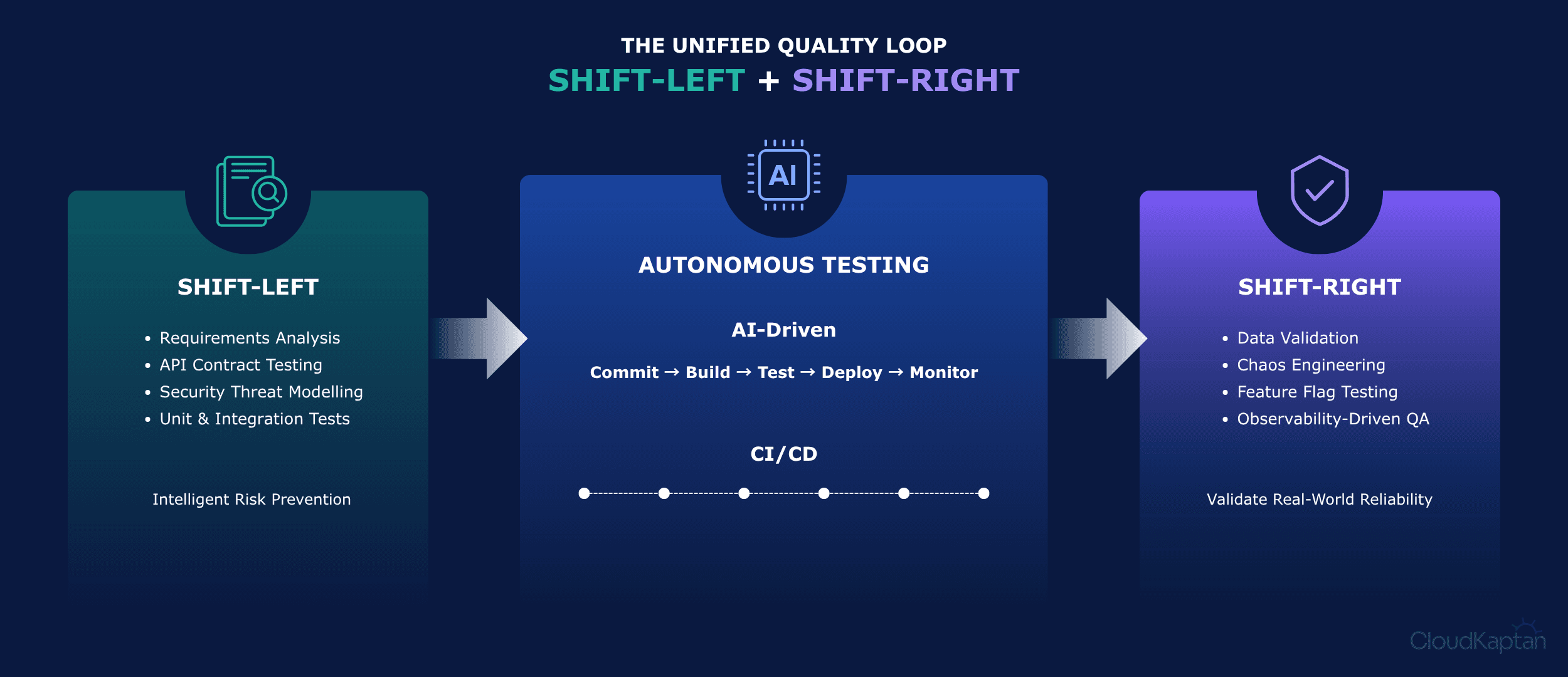
Shift-left helps prevent issues early by validating requirements, architecture decisions, API contracts, and business rules. Shift-right extends that confidence into production through observability, performance monitoring, resilience validation, and feedback from real system behaviour.
How Enterprises Can Stay Ahead
Staying ahead in Quality Engineering is not primarily a tooling challenge. It is a capability and positioning challenge. The organisations that manage transformation more effectively are usually the ones that bring quality into architecture, measure it through business outcomes, and create visibility into risk before production issues occur.
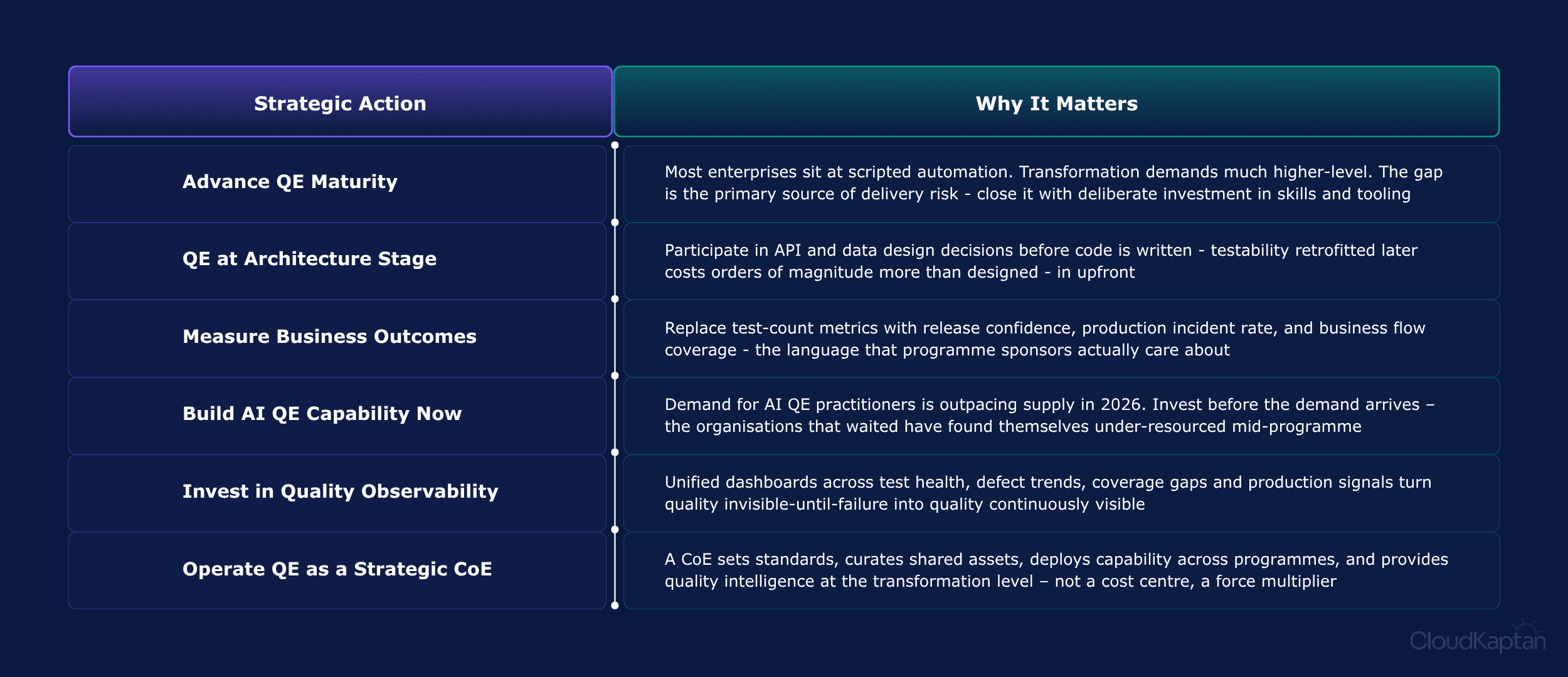
The QE Maturity Gap Where Most Organisations Stand and Where They Need to Be
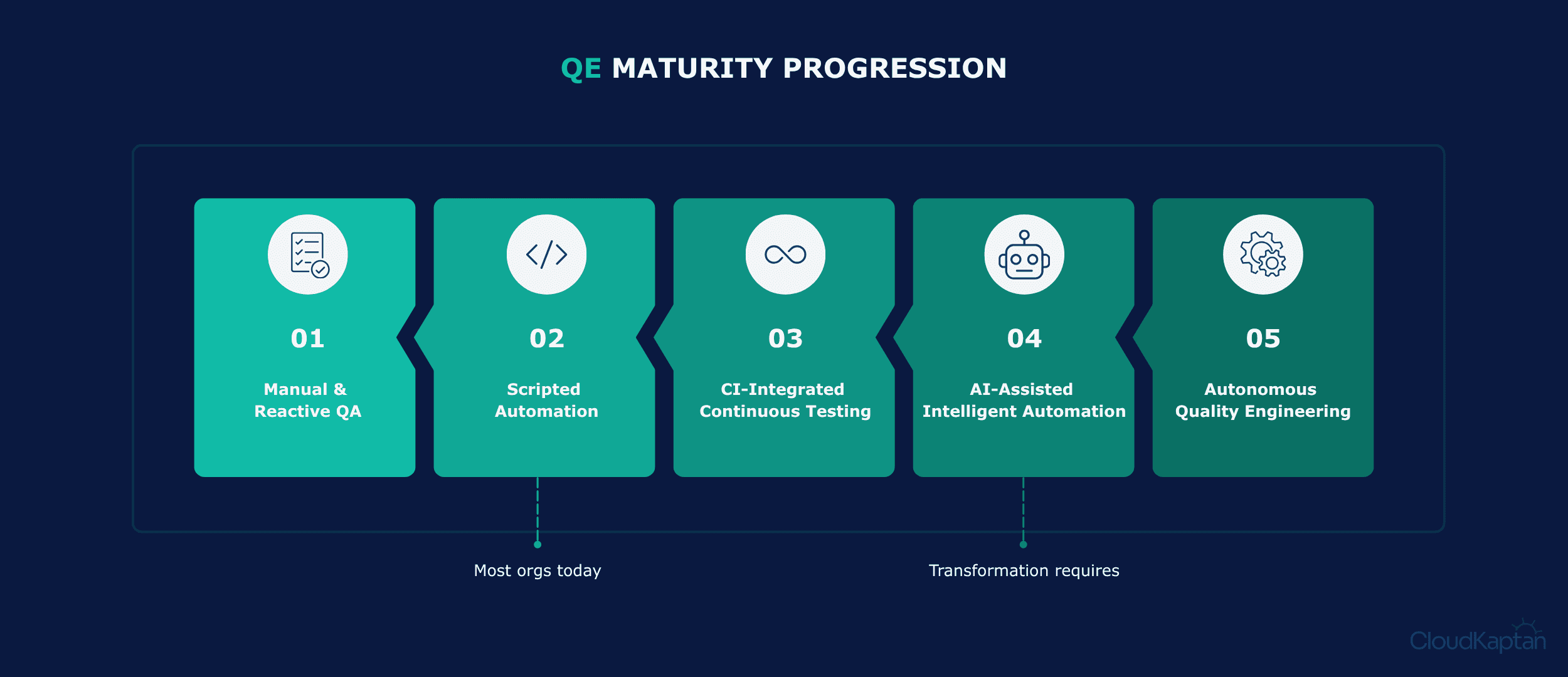
Most enterprises sit at Level 2, or scripted automation. Most digital transformation programmes demand Level 4 capability. The gap between the two is where delivery risk concentrates and where CoE investment produces the highest return.
QE maturity progression: from manual reactive testing to autonomous quality engineering
A mature Quality Engineering function does more than increase test coverage. It brings structure to how quality is planned, engineered, measured, observed, and improved across programmes. It also gives decision-makers a clearer view of whether transformation is ready to scale and where controls need to be strengthened before go-live.
Final Thought
Digital transformation is one of the most consequential investments an enterprise can make. The business case may begin with speed, efficiency, customer experience, or innovation, but the outcome depends on how reliably the underlying systems perform when they reach real users, real data, and real operating conditions.
Quality Engineering does not reduce risk by slowing transformation down. When embedded early and applied continuously, it gives delivery teams and programme sponsors the confidence to move faster with fewer blind spots. It helps validate integration layers, protect business-critical workflows, strengthen release decisions, and reduce the risk of discovering quality gaps after go-live.
For enterprises modernising core platforms, scaling AI initiatives, migrating ERP systems, or connecting complex digital ecosystems, QE is no longer only a testing function. It is a strategic capability that supports reviewed releases, stronger resilience, and more predictable transformation outcomes.
Organisations that continue to treat quality as a downstream expense often pay for its absence later through delays, rework, operational disruption, and loss of stakeholder confidence. On the contrary, ones who build Quality Engineering into the transformation journey at an early stage are better positioned to turn digital ambition into reliable business value.
