Salesforce
Artificial Intelligence
Why Smarter AI Agents Depend on Salesforce Foundations
Article

CK Editorial Team
5
min read

A recent report found that 97% of business leaders view AI as a long term investment, yet 48% say their organizations lack enough high-quality data to operationalize it at scale. A further 75% identify good-quality data as the most valuable factor in improving generative AI capability.
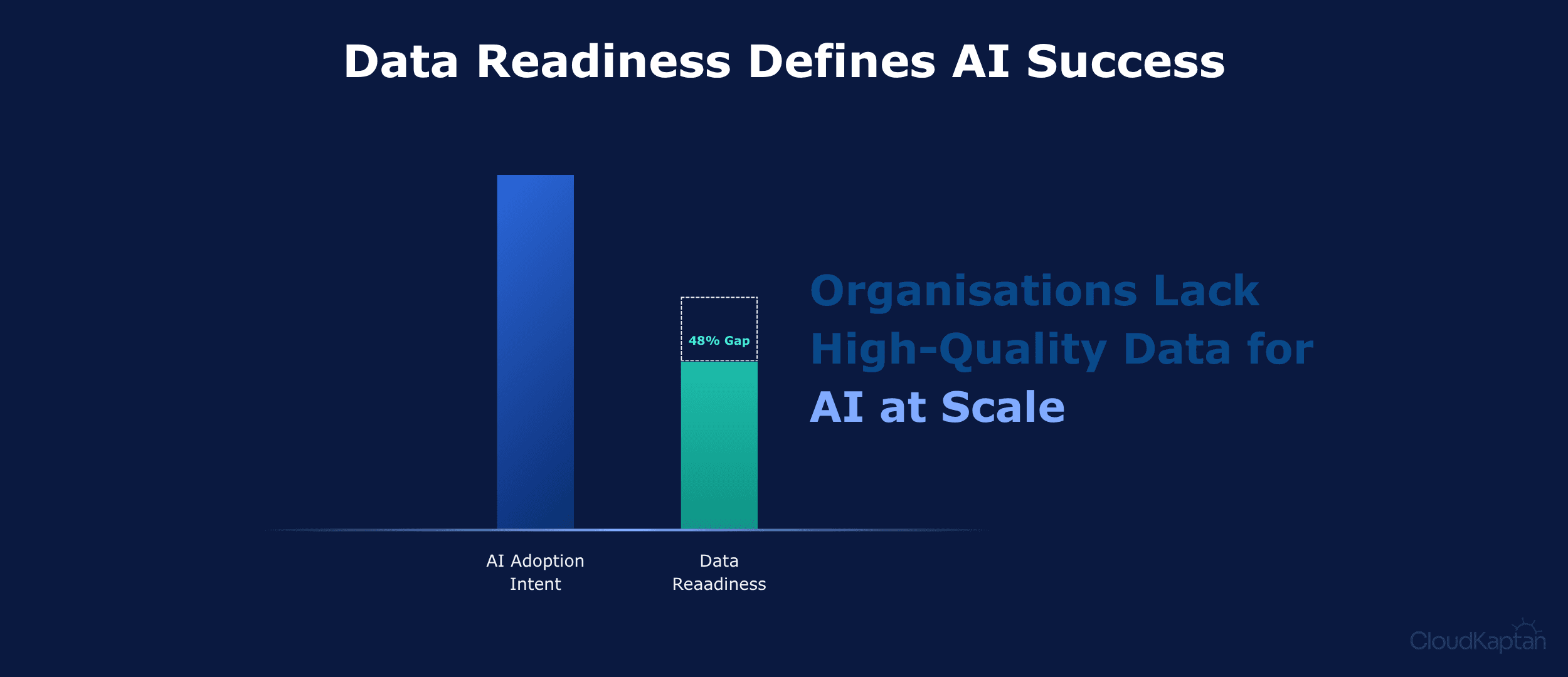
With data points like these, one thing becomes clear: the real obstacle to AI scale is not interest, investment, or even access to the technology itself. It depends on whether the underlying systems are ready to support it.
Inside Salesforce, that often means AI is forced to work with fragmented data, layered workflows, and increasingly complex customer context. The result is not always visible failure, but outputs that sound right at first glance and still fall short when decisions, timing, and business context actually matter.
Bridging the Gap between Strategy and Execution
For enterprise leaders, the value proposition behind AI in Salesforce is straightforward. It is about achieving higher seller productivity, stronger forecasting support, faster service, less manual effort, and better orchestration across the customer lifecycle.
The difficulty starts when those outcomes need to be operationalized across workflows, shared data models, and cross functional processes. The market shift toward Agentic AI and embedded CRM intelligence is accelerating. However, value realization still depends on connected data, governed workflows, and reliable decision signals.
That is why many early AI programs do not break down at the model layer and lose precision at the operating layer itself.
Why Salesforce AI Depends on CRM Structure
Salesforce AI is only as effective as the CRM context it can resolve.
What it sees, prioritizes, and recommends is defined by your object model, field semantics, workflow logic, access boundaries, metadata quality, and the orchestration across sales, service, and post-sales operations. When these layers are coherent, AI delivers faster, more relevant outputs. But in environments marked by schema sprawl, overlapping automation, and inconsistent governance, output quality gradually deteriorates.
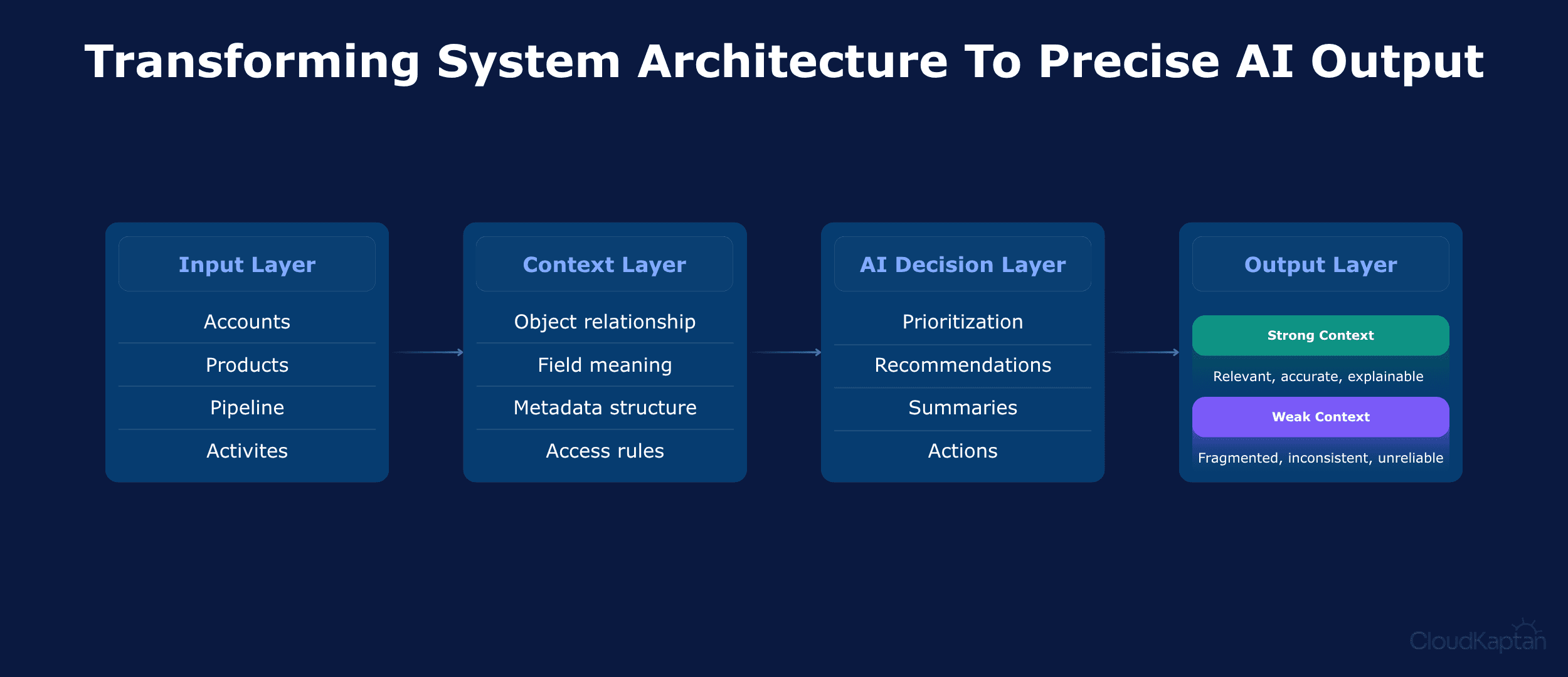
That pattern usually shows up in four familiar places:
Context resolution weakens when account history, product signals, and pipeline movement are distributed across disconnected records instead of forming one usable decision layer
Grounding quality drops when summaries, recommendations, and generated actions rely on fragmented metadata, stale records, or content that is not structured for retrieval
Workflow execution loses precision when AI inherits legacy routing logic, exception heavy approvals, and process paths that no longer reflect current operating reality
Trust becomes harder to scale when teams cannot trace which signals, rules, or sources informed the output in the first place
What Enterprise Leaders Should Reassess First
If Salesforce AI is not delivering the value you expected, it is often framed as a model limitation, a prompt design issue, or a change management gap. While those factors can influence outcomes, they are rarely the primary constraint in mature environments.
The more fundamental issue is operating context maturity. Industry research shows that successful generative AI adoption depends on integrating AI with enterprise data and infrastructure, establishing strong governance, and aligning use cases to measurable business value. It also highlights that connected, well-governed data is essential for scaling AI, as it provides the context required for accurate and reliable outputs.
This is the reframe enterprise leaders need to make. AI readiness is not primarily a tooling decision, it is a function of CRM architecture, data governance, and the operating model that connects systems, teams, and workflows.
How do you Enable Salesforce to Scale AI Agents?
So, what prepares Agentforce for reliable performance at scale? It starts with data readiness, retrieval quality, and governance that can support reliable execution.
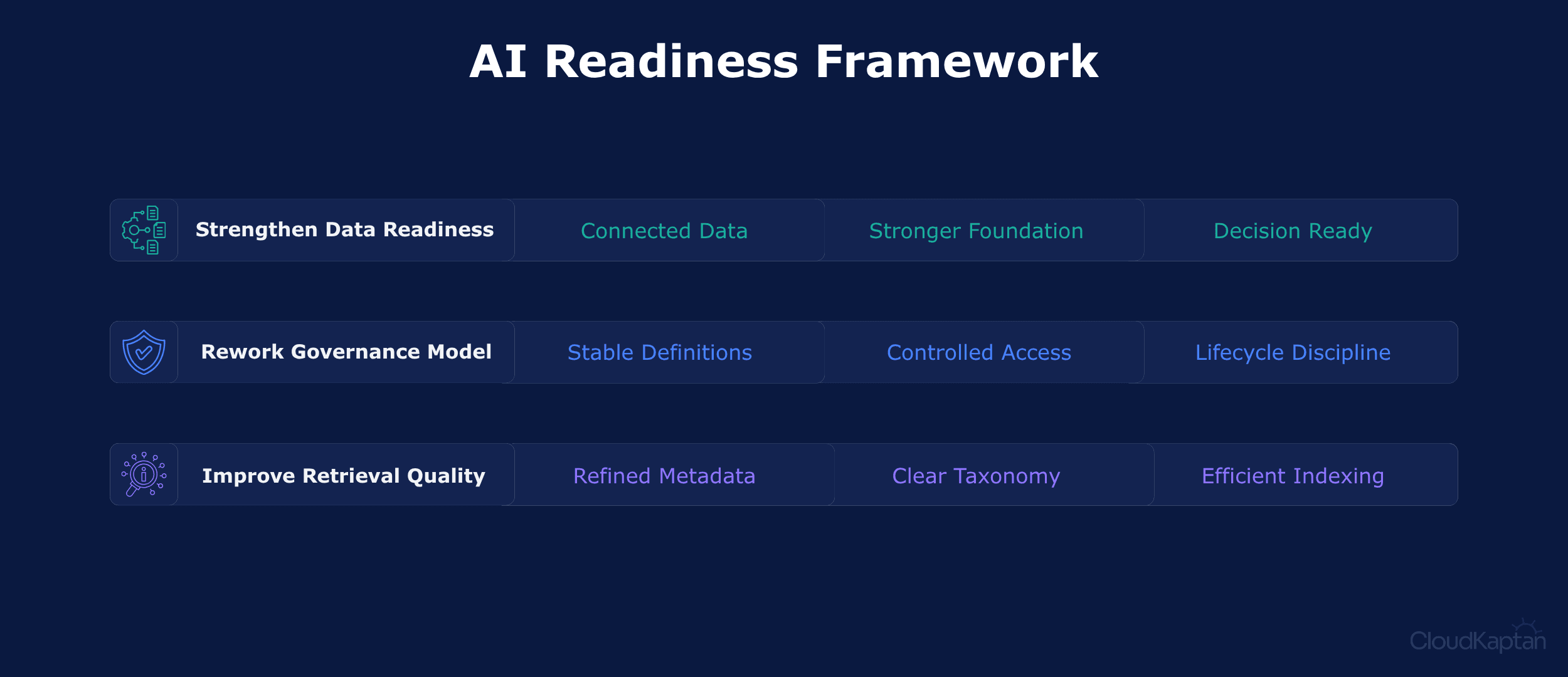
Strengthen data readiness by making enterprise data more connected, usable, and decision ready across both structured and unstructured sources. The goal is not simply cleaner records, but a stronger data foundation that gives AI the context it needs to operate with relevance and precision.
Rework the governance model so AI is operating on stable definitions, controlled access, and a more disciplined data lifecycle. As the environment scales, governance becomes the difference between reliable output and structural inconsistency.
Improve retrieval quality by refining metadata, taxonomy, and indexing strategies particularly across systems like Salesforce Data Cloud and knowledge bases used by Agentforce.
Introduce readiness scoring and refinement so content, records, and knowledge assets are assessed for clarity, relevance, and interpretability before they are used to ground AI outputs. High value assets should be prioritized first, especially where usage is frequent and decisions carry greater impact.
Make readiness continuous by using AI to support classification, summarization, monitoring, and ongoing improvement across the data layer. Reliable performance does not come from a one time cleanup. It comes from continuous refinement based on real usage, query behaviour, and output quality.
Driving Efficiency Through Unified AI Intelligence
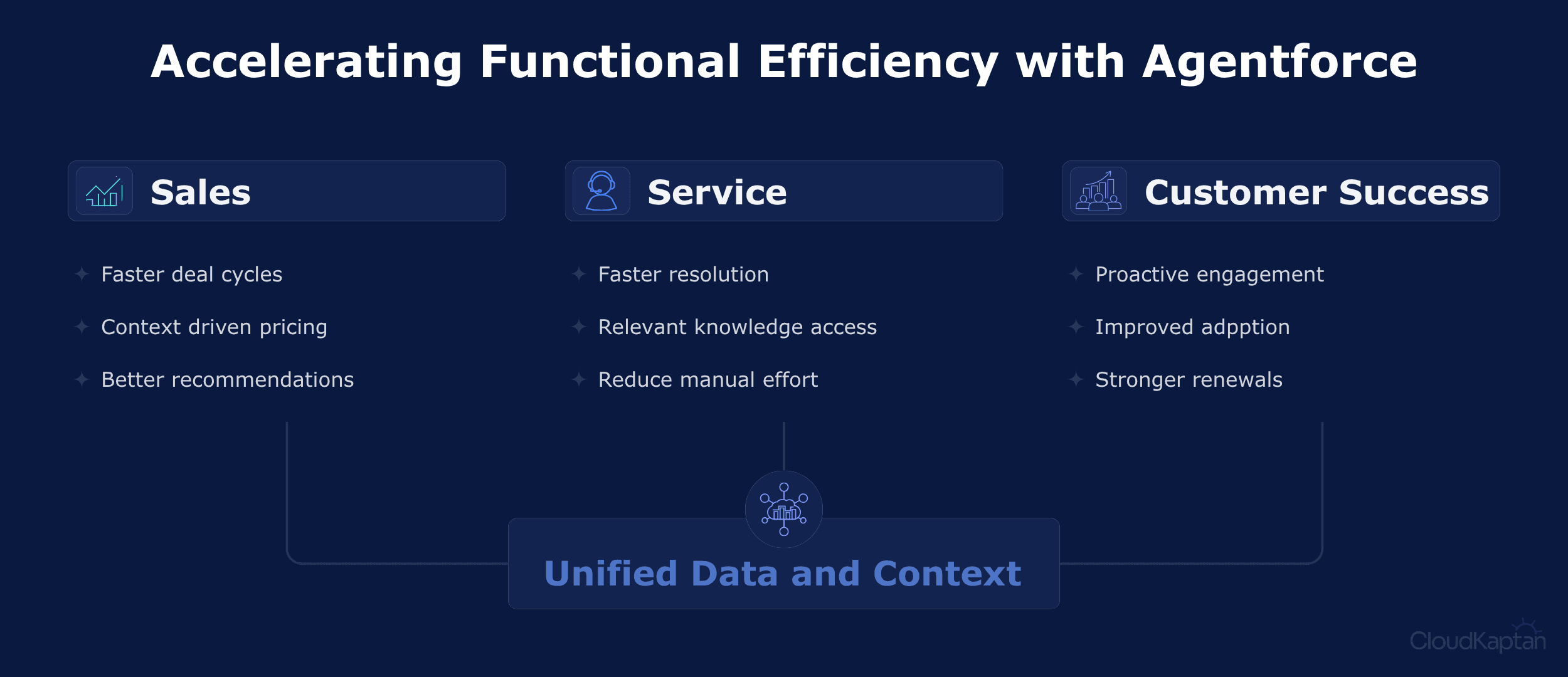
These gaps are not limited to backend system layer, but they directly shape how teams operate across key functions.
In Sales, the impact is clearest in quoting, pricing, and offer creation. AI becomes more useful when it can respond to customer inputs, shorten slow sales cycles, and support tailored recommendations using live account, contract, and lifecycle context.
Across service, the benefits are tied to execution. Faster access to case history, relevant knowledge, and prior interactions can improve response quality and reduce handle time, especially where agents would otherwise need to search across fragmented documentation and support records.
In customer success, the value comes through onboarding, adoption, renewals, and expansion. AI is most effective when usage signals, customer context, and workflow triggers are connected well enough to support proactive guidance, timely interventions, and more informed renewal planning.
Preparing Your Foundation For Agentforce Scaling
The real value of AI in Salesforce does not come from deploying more intelligence into the system but from giving that intelligence the right foundation to work with. When data is more connected, workflows are better governed, and context is easier to retrieve, AI becomes far more effective across all sectors.
For organisations still working through that shift, the focus should be on building a stronger foundation with the support of a partner that guides the transition with clarity and confidence.
Are you ready to strengthen your Salesforce foundation for Agentforce and AI to scale? Connect with our team to get started.
