Data
Artificial Intelligence
Databricks
The True Cost of Consumer Frauds Across Financial Services
Article

CK Editorial Team
4
min read

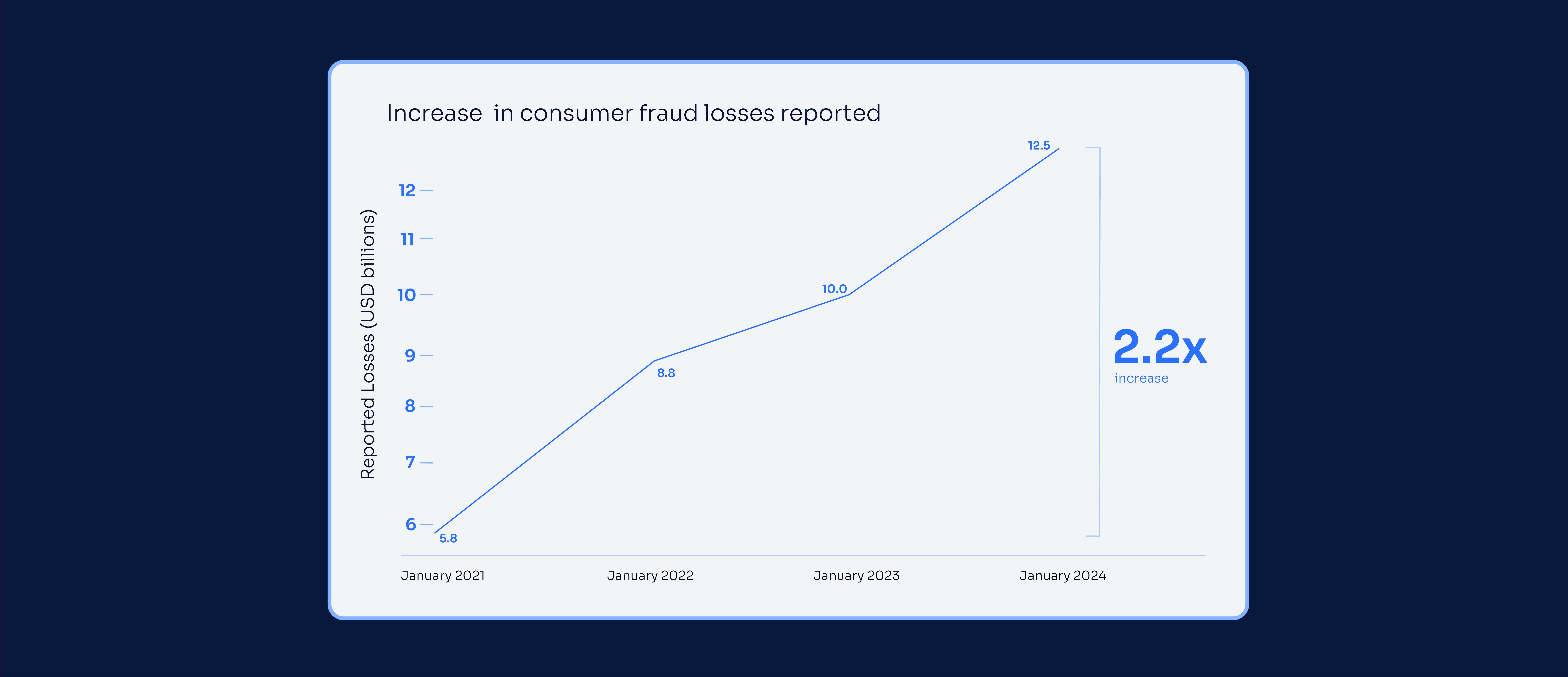
Consumer fraud continues to evolve as digital banking adoption expands and more financial interactions move online, fraudsters are finding new ways to exploit consumers and access financial systems. Recent data suggest that consumer fraud losses now exceed $12 billion annually, highlighting that the financial crime is becoming more organised targeting both individuals and the financial institutions that serve them.
To better understand how fraud tactics are evolving, researchers across the financial services industry have analysed large-scale fraud datasets, identifying several emerging patterns shaping the modern fraud landscape. These patterns reveal that fraud is no longer random or isolated, it is increasingly structured, and driven by repeatable behaviours that can be observed across institutions.
Consumer Fraud is becoming Network-Driven
Modern consumer fraud rarely relies on a single identity. Instead, fraud operations increasingly resemble coordinated networks where one actor controls dozens of digital identities, documents, and accounts across financial systems.
These networks allow fraudsters to spread activity across different touchpoints, making detection significantly more difficult for financial institutions. A single operation may involve multiple email addresses, phone numbers, devices, IP addresses, along with reused or manipulated documents such as bank statements, income proofs, and identity records.
Rather than acting through a single account, a fraud actor can operate many accounts simultaneously, shifting between identities and documents to bypass verification checks and extend the lifecycle of fraudulent activity.
This structure is becoming more common across financial services. As customer onboarding, verification, and transactions move online, fraud increasingly spans the entire customer journey from account creation and document submission to login behavior and financial activity.
As a result, fraud is no longer isolated or random. It is organized, repeatable, and capable of scaling across systems, laying the foundation for patterns that financial institutions can begin to identify and analyse.
Financial Frauds is Becoming Predictable through Repeatable Patterns
As fraud becomes more organized, it also becomes more predictable. Rather than isolated incidents, modern fraud increasingly follows repeatable patterns that can be observed across identities, documents, and accounts.
Fraudsters often reuse the same tactics across multiple attempts. This may include submitting variations of the same identity, reusing or manipulating documents such as bank statements and income proofs, or creating multiple accounts with slight modifications to bypass verification checks.
These patterns are not random. They emerge because fraud operations are designed to scale. A single actor or group may test different combinations of identities, documents, and access points until they identify gaps in verification or monitoring systems.
For financial institutions, this creates both a challenge and an opportunity. While fraud attempts become more frequent, they also leave behind consistent signals across document structures, identity attributes, and behavioural activity that can be analysed and detected.
As a result, fraud detection is shifting from identifying isolated anomalies to recognizing patterns across data. Institutions that can connect these signals across systems are better positioned to detect fraud earlier, before it progresses to financial loss.
Common Fraud Patterns in Identity and Document Based Fraud
As fraud becomes more structured and scalable, certain patterns consistently emerge across identity and document-based fraud scenarios. These patterns are often repeated across multiple accounts, making them easier to detect when analysed at scale.
Identity reuse and variation
Fraudsters frequently reuse the same identity attributes across multiple attempts, making slight modifications to bypass verification checks. This may include variations in names, addresses, or contact details while maintaining underlying similarities across records.
Document manipulation and reuse
Financial documents such as bank statements, income proofs, and identity records are often reused or altered across applications. Fraudsters may edit values, change formats, or submit similar documents multiple times to gain approval across different accounts.
Multiple account creation
A single fraud operation may create several accounts using different combinations of identities and documents. These accounts are often used in parallel to increase the chances of success or to distribute risk across multiple entry points.
Behavioural consistency across attempts
Even when identities and documents are varied, fraud attempts often show consistent behavioural patterns such as repeated submission timing, similar interaction flows, or recurring device and access signals.
Together, these patterns highlight a key shift in modern fraud. Rather than isolated incidents, fraud increasingly operates through repeatable methods that can be identified when data is analysed across systems.
The True Cost of Financial Fraud
The impact of fraud extends far beyond direct financial losses. For financial institutions, fraud introduces additional operational, compliance, and reputational costs that significantly increase its overall burden.
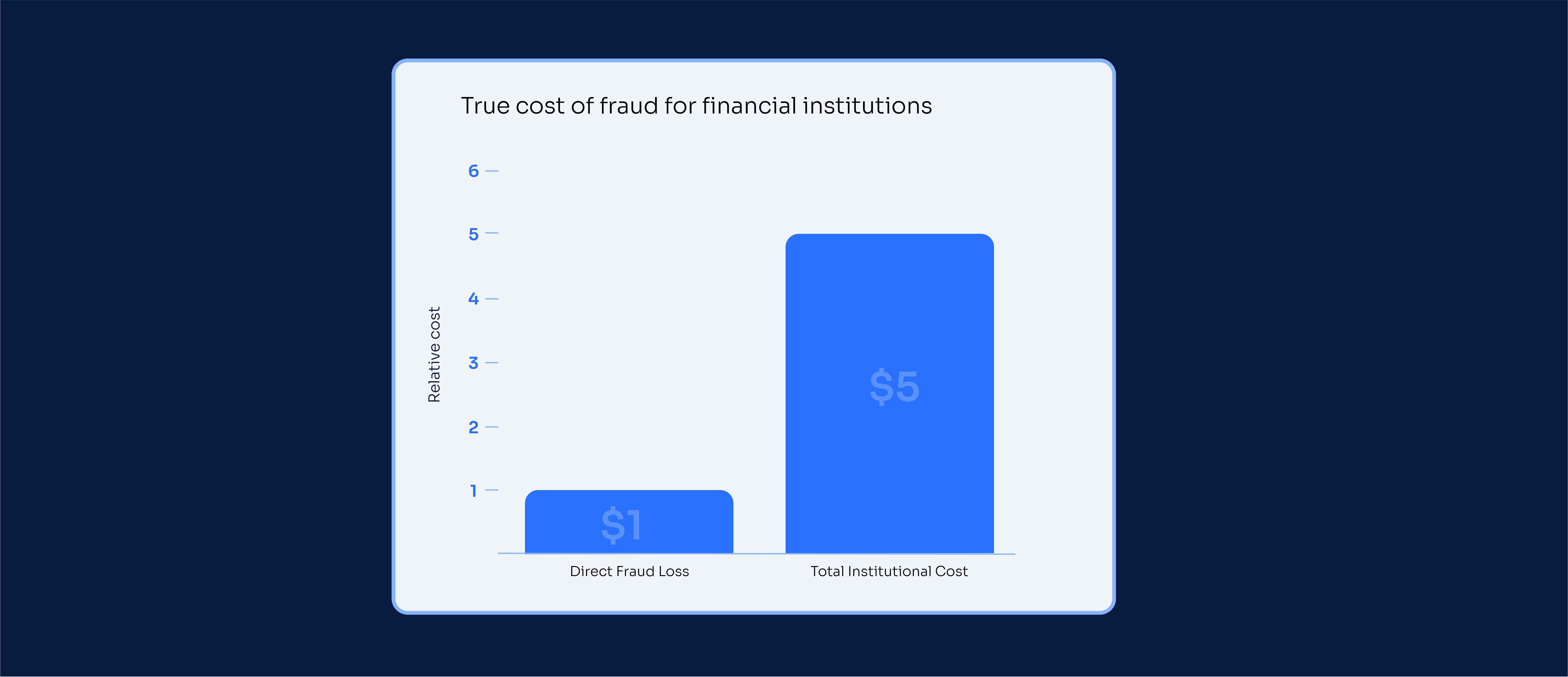
Industry research shows that the total cost of fraud now averages more than $5 for every $1 lost, once investigation efforts, regulatory requirements, and customer remediation are taken into account.
As fraud becomes more organized and scalable, these costs continue to rise. Identity-based and document-driven fraud, in particular, can trigger repeated verification efforts, manual reviews, and compliance interventions across multiple systems.
This creates a compounding effect. A single fraudulent identity or manipulated document can lead to multiple downstream costs across onboarding, monitoring, and remediation processes.
As a result, financial institutions are increasingly focused on detecting fraud earlier in the lifecycle, before it propagates across systems and leads to higher operational and financial impact.
What We’re Building to Help
Our goal is to help financial institutions detect fraud earlier by connecting data across the customer lifecycle. As fraud becomes more structured and pattern-driven, detection depends on identifying signals across identities, documents, and transactions.
Using Lakehouse architectures, AI and data analytics, institutions can unify onboarding, document verification, and transaction data to detect patterns at scale. Master data management and compliance dashboards provide a centralized view of risk, enabling identity resolution, faster investigations across siloed systems and improved audit readiness.
These capabilities can be augmented through integrations with third-party providers for identity and document validation, helping institutions move from reactive detection to proactive fraud prevention.
