
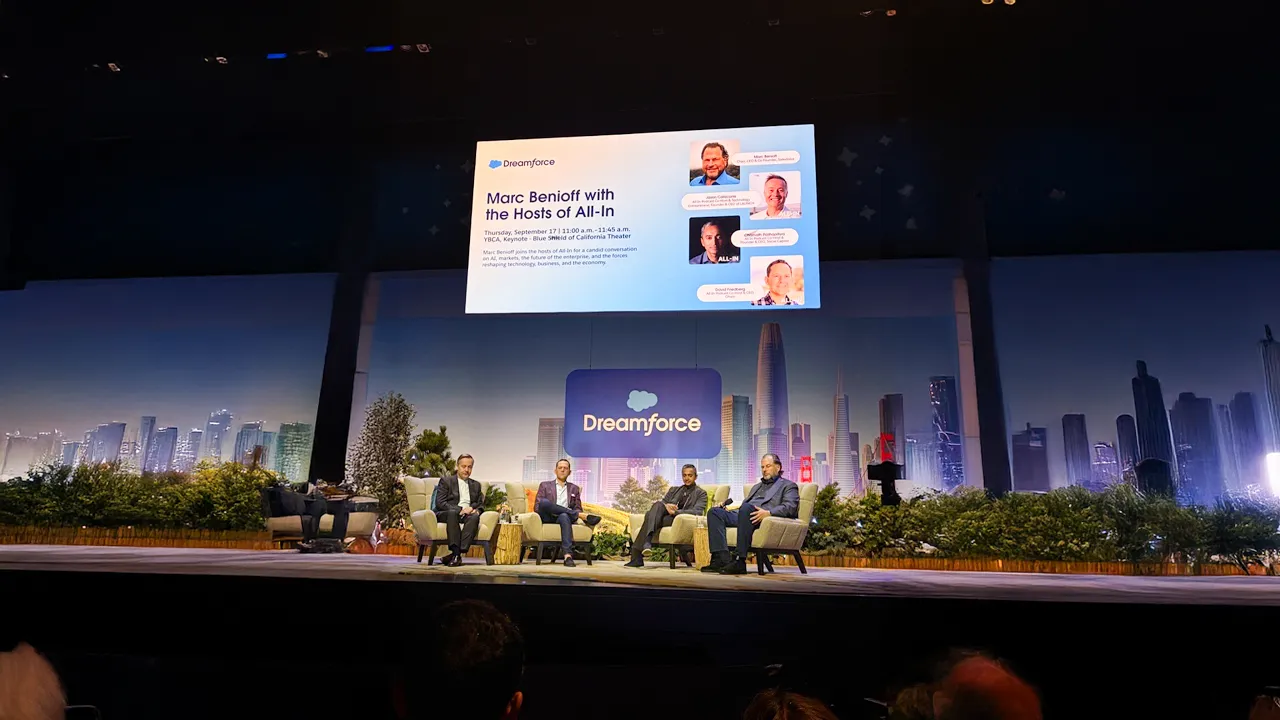
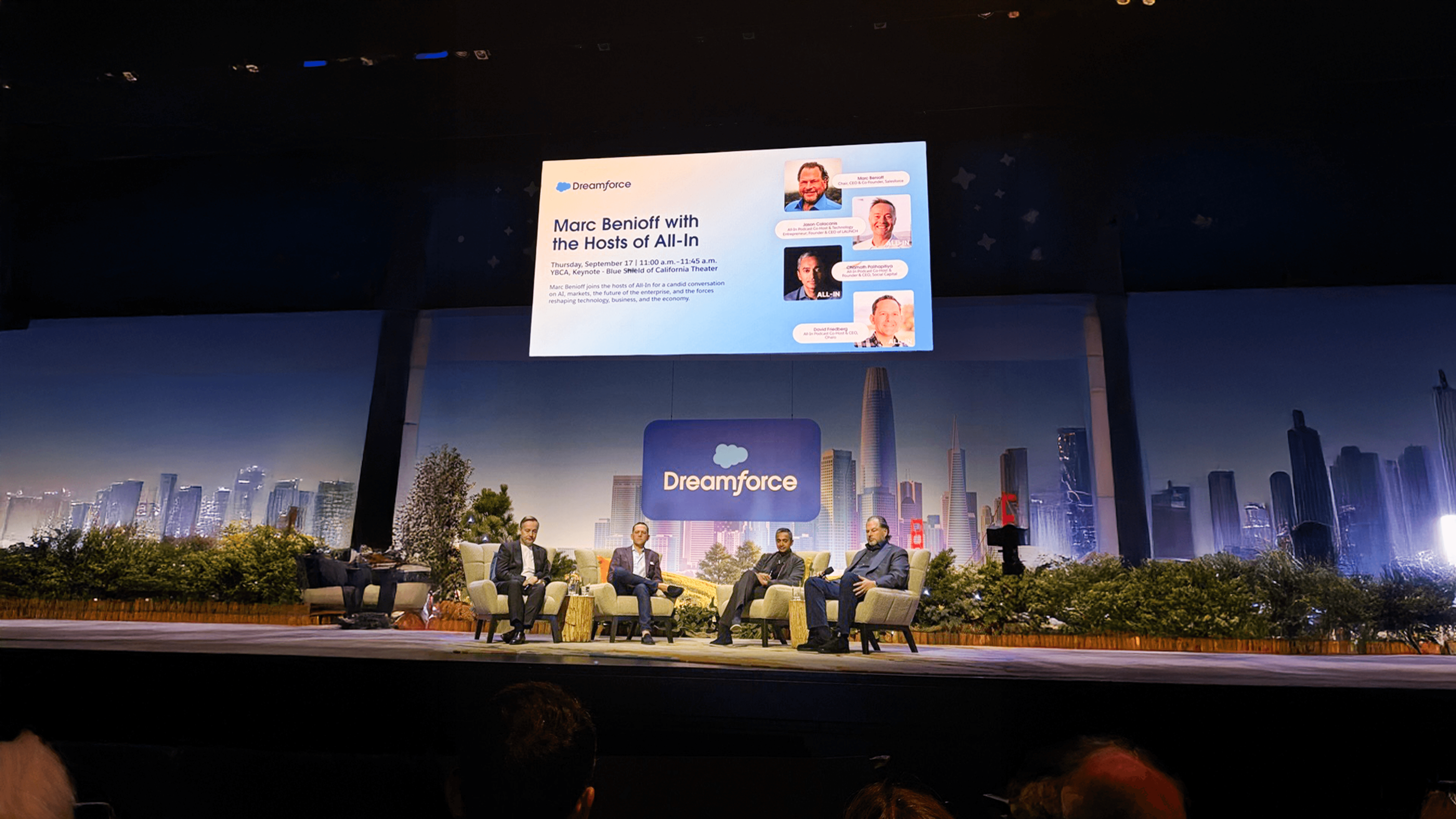
Dreamforce 2026 arrived at a point where enterprise AI is moving beyond experimentation and deeper into the operating fabric of the business. Earlier this month, we joined the Salesforce community in San Francisco for Dreamforce 2026, and hosted the CloudKaptan Happy Hour alongside the event.
One idea that stood out to us was: Salesforce is becoming less dependent on a fixed application interface and increasingly accessible through the AI and collaboration environments where people already work. Among the major announcements we have picked few that show this shift clearly.
Here's what we witnessed, learned, and believe will shape the next chapter of Salesforce and Agentic transformation.
AIforce
AIforce was perhaps the most consequential announcement because it changes the architecture of interaction, not simply the Salesforce feature set.
It is a live interface layer that brings Salesforce data, workflow logic and permissions to whichever surface people and agents work in, in place of a fixed UI.
It is built on the Headless Toolkit, the open architecture that exposes the platform through MCP servers, APIs, plug-ins and skills, and it sits on top of the existing stack:
Data 360 for unified context
Customer 360 for business logic and permissions
Agentforce for the agent workforce
Interfaces are composable: describe the view you need, and the system assembles it around the task at hand.
The signal is a decoupling of the presentation layer from the system of record.
If the screen is no longer fixed, the durable value sits beneath it: the integrity of the data model, the rigour of the permission design, the quality of the underlying business logic.
Because agents operate within existing permissions, any inconsistency in an org's access model travels with them. For partners, the work shifts from configuring screens to orchestrating context, access and governance across every surface.
Claudeforce
Claudeforce is the Salesforce–Anthropic partnership, a plugin with 37 prebuilt sales skills designed delivered as a packaged experience called Salesforce in Claude.
It brings Salesforce data, workflows and governance directly into Claude through a prebuilt MCP server, removing the need for custom authentication and skill wiring.
Customers get Claude's reasoning while CRM permissions and data access rules stay intact.
The significance is fairly straightforward. The model becomes a reasoning layer that plugs into Salesforce context, rather than a separate destination that needs its own integration.
For partners, it opens room for solutions in active collaboration spaces, operational processes and AI interactions.
For users, it shortens the distance between analysis, decision and execution.
Slackforce
Slackforce takes the same premise into collaborative work.
It is a live AIforce interface inside Slack, a multiplayer, conversational way to turn Salesforce data into live, interactive experiences, generated from what users ask for in conversation.
These surfaces can draw from Sales Cloud, Service Cloud, Data 360 and Tableau while allowing teams to filter, explore, discuss and act on the information together.
Together with Slackbot and the broader AI experience inside channels, this makes Salesforce less of a separate destination and more of an active part of the team workflow.
Data, conversation and action begin to occupy the same collaborative context, reducing the gap between identifying something important and acting on it.
For consulting partners, it is another surface to extend Salesforce intelligence, custom workflows and autonomous agents into the environments where teams already work every day.

The conversations we are taking forward
Some of our favourite moments from Dreamforce came from the conversations around the event itself.
We hosted our long awaited and anticipated CloudKaptan Happy Hour, where we had the opportunity to reconnect with Salesforce and Agentforce experts, spend time with partners, familiar faces, and meet many new people from across the ecosystem. It gave us a different setting to continue many of the discussions that had been unfolding throughout Dreamforce.
Our discussions kept returning to five threads: Headless 360, Agentic AI, Data, Automotive and Financial Services. Whether it was how headless architectures change the way solutions are designed, or how agentic patterns are taking shape in regulated and high-volume industries, the exchanges were candid, curious and generous with ideas.
It was a great evening with good company, technical conversation and a room full of people who care about where all of this is heading. We are grateful to everyone who made it what it was, and we are already looking forward to the next one.
Wrapping up
Dreamforce 2026 reinforced that the Agentic Enterprise is moving from roadmap to operating model. The organisations that can orchestrate it, adapt around it and sustain it will turn this moment into lasting value, and the ecosystem that surrounds them, partners included, will be central to that.
Participating in Dreamforce’26 was a significant milestone for CloudKaptan, and hosting our Happy Hour was a highlight we will remember for the people and conversations it brought together. We are energized by how our solutions and services are set to shape the future of Agentic AI across major industries.
Thank you to everyone who joined us in San Francisco. We look forward to continuing the conversation.
